CIVICSPREPUSA · CITIZENSHIP INTERVIEW PREPARATION
Learn the English words that can help you understand your citizenship interview.
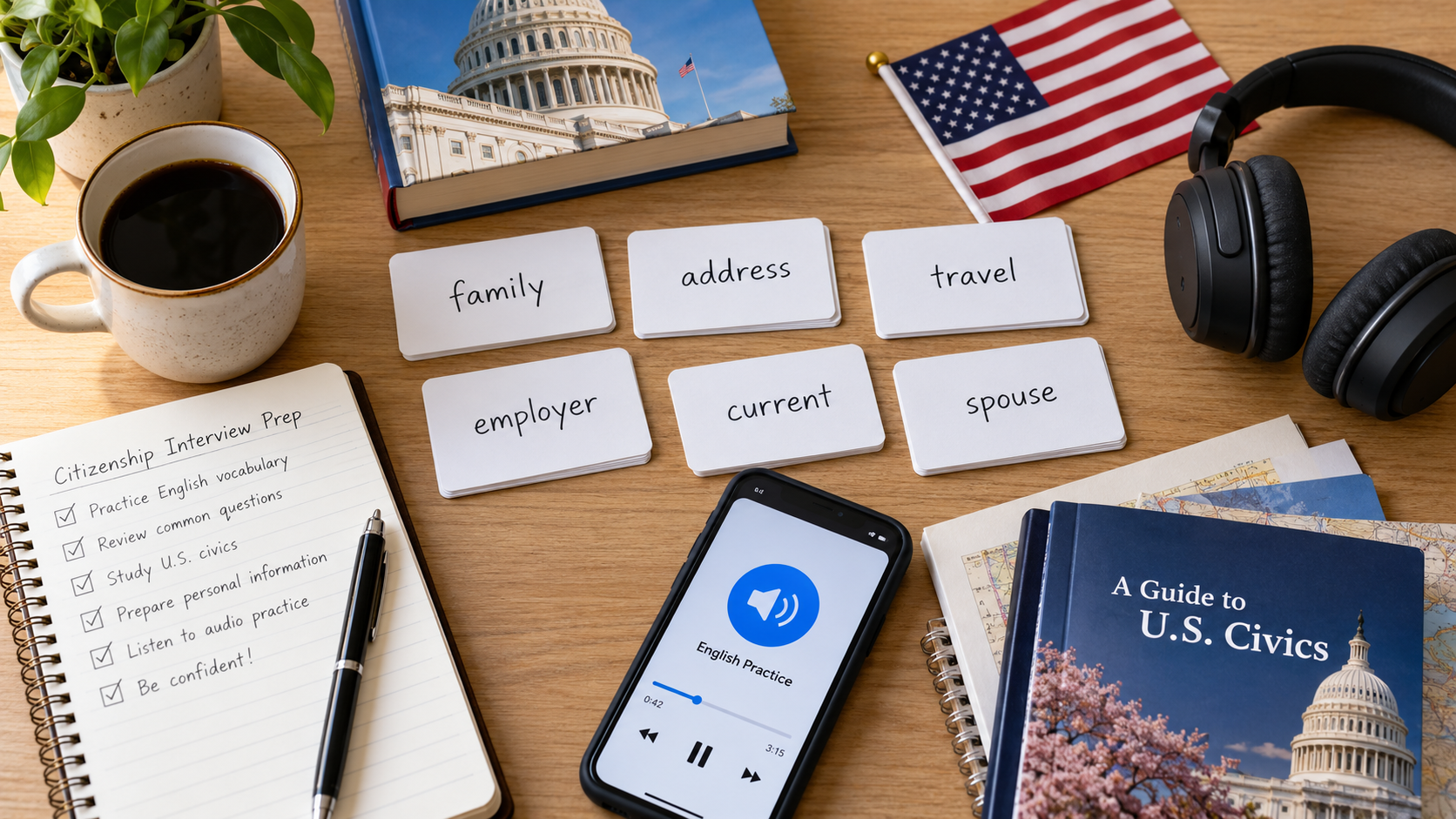
Practice words about your family, job, address, travel, Form N-400, and common USCIS interview instructions.
You have studied the citizenship questions.
You know facts about American history and government.
But during your citizenship interview, the USCIS officer may ask questions about something different.
Your address.
Your job.
Your family.
Your travel outside the United States.
You may know all this information. But what happens if you do not understand an important English word in the question?
Learning useful English vocabulary can help you understand the officer and explain your own information more clearly.
You do not need to memorize an entire English dictionary.
Instead, focus on words connected to your life, your Form N-400, and the naturalization interview.
At CivicsPrepUSA, we believe learning words in small groups and practicing them in real sentences can make your study time more useful.
This guide will help you get started.
Quick Answer: Which English Words Should I Study?
Before your citizenship interview, practice words from these seven groups:
- Question words: What, where, when, who, why, and how.
- Personal information: Name, birth, address, and residence.
- Family and work: Spouse, married, employer, and occupation.
- Time and travel: Before, after, since, during, and outside.
- Interview instructions: Read, write, sign, wait, and follow.
- Important application terms: Ever, never, prior, and other words found in Form N-400 questions.
- Citizenship terms: Government, Constitution, Congress, and citizen.
These are useful study groups, not a complete official USCIS vocabulary requirement.
The most important goal is to understand the words when you hear them and know how to respond truthfully.
Why Is English Vocabulary Important During the Citizenship Interview?
During your naturalization interview, a USCIS officer reviews your application and asks questions about your background.
For applicants who must meet the English requirements, the naturalization test includes speaking, reading, and writing.
USCIS evaluates your speaking ability through your responses to questions normally asked during the interview about Form N-400.
The reading and writing tests are separate parts of the English test.
USCIS provides official vocabulary lists for those two parts.
It also provides special practice activities for understanding common words and instructions during the interview.
These resources serve different purposes.
Knowing words from the reading test does not mean you have learned all the words you may need to understand during your Form N-400 interview.
That is why your English preparation should include listening and speaking, not just reading and memorizing.
1. What Question Words Should I Know?
Start with question words.
These small words can tell you exactly what information the officer wants.
| English Word | Simple Meaning |
|---|---|
| What | Asks for information |
| Where | Asks about a place |
| When | Asks about a time or date |
| Who | Asks about a person |
| Why | Asks for a reason |
| How | Asks about a way, condition, or amount |
Now look at these practice questions.
What is your full name?
The officer wants your name.
Where do you live?
The officer wants to know your home location.
When were you born?
The officer wants your date of birth.
Who is your employer?
The officer wants to know who employs you.
How long have you lived at your current address?
The officer wants a period of time.
Notice that the question words change what you need to say.
A date is not the same as a place.
A person’s name is not the same as a period of time.
Practice the Difference Between When and How Long
Consider these two questions:
When did you move here?
You might answer with a date.
“I moved here in 2022.”
How long have you lived here?
You might answer with an amount of time.
“I have lived here for four years.”
Both sentences can describe the same situation, but they answer different questions.
These are teaching examples, not a guaranteed list of questions an officer will ask.
2. What Personal Information Words Should I Know?
The USCIS officer may review the personal information on your Form N-400.
You should recognize words connected to your identity and where you live.
| English Word or Phrase | Meaning |
|---|---|
| Full name | Your complete name |
| Given name | Your first name |
| Family name | Your last name |
| Date of birth | The day, month, and year you were born |
| Place of birth | Where you were born |
| Country of birth | The country where you were born |
| Current address | Where you live now |
| Previous address | Where you lived before |
| Residence | The place where you live |
| Permanent resident | A person with lawful permanent resident status |
Practice With Your Own Information
Try answering these example questions aloud.
- “What is your full name?”
- “What is your date of birth?”
- “What country were you born in?”
- “What is your current address?”
- “Where did you live before?”
Use your real information when you practice.
Do not memorize someone else’s name, address, or dates.
For example:
“My name is Maria Lopez.”
“I was born on March 12, 1985.”
“I live in New Jersey.”
These are sample answers. Your answers must match your own circumstances.
Learn Words Together
Instead of studying only the word “address,” learn:
- Current address
- Previous address
- Home address
Then practice sentences using each phrase.
This helps you understand the word in context.
3. Which Family and Employment Words Are Useful?
The officer may also review information about your family and work history.
Family Vocabulary
| Word | Meaning |
|---|---|
| Spouse | Your husband or wife |
| Married | Legally married |
| Single | Not married |
| Divorced | A marriage was legally ended |
| Widowed | Your spouse has died |
| Child | A son or daughter |
| Dependents | People who depend on you for support |
Practice questions:
- “Are you married?”
- “Do you have any children?”
- “What is your marital status?”
Use the answers that accurately describe your situation.
Employment Vocabulary
| Word | Meaning |
|---|---|
| Employment | Having a job or paid work |
| Employer | A person or business that employs you |
| Occupation | The kind of work you do |
| Employed | Working at a job |
| Unemployed | Not currently employed |
| Self-employed | Working for yourself |
| Previous employer | A person or business you worked for before |
Practice questions:
- “Where do you work?”
- “What is your occupation?”
- “Who is your employer?”
- “Where did you work before?”
Your responses should describe your real work history.
If your situation is unusual, such as self-employment or several jobs, practice explaining it in simple, accurate English.
You do not need to invent a different job title to make your answer easier.
4. Why Are Time Words So Important?
Some of the most important interview words are not names or places.
They are words about time.
| Word | Meaning in Ordinary English |
|---|---|
| Current | Happening or true now |
| Previous | Earlier; before now |
| Prior | Before |
| Since | From a starting time until a later time |
| During | Within a period of time |
| Before | Earlier than something |
| After | Later than something |
| Ever | At any time |
| Never | Not at any time |
| Frequently | Often |
| Habitually | Usually or regularly, as a habit |
These words can change the meaning of a question.
Current and Previous
“What is your current address?”
This asks where you live now.
“What was your previous address?”
This asks where you lived before.
Since and Before
“Where have you worked since 2022?”
This asks about a period beginning in 2022.
“Where did you work before 2022?”
This asks about an earlier period.
Ever and Never
The word ever is especially important when reviewing questions about your history.
“Have you ever…” asks whether something happened at any time within the period described by the complete question.
“Never” means that something did not happen at any time within the period being discussed.
Important: Do not answer a question based only on one word. Listen to the complete question, including any dates or limits.
Some Form N-400 questions have important legal meanings. You must understand the full question, not just its everyday vocabulary.
If you are unsure what a question on your actual application means, get reliable help before the interview.
5. What Travel Words Should I Practice?
USCIS may review information about your travel outside the United States.
Here are useful words to study:
- Travel: Go from one place to another.
- Trip: A journey.
- Departure: Leaving a place.
- Return: Coming back.
- Outside the United States: In another country.
- Passport: An official travel and identity document.
- Duration: The length of time something lasts.
- Date of departure: The date you left.
- Date of return: The date you came back.
Practice with questions such as:
- “Have you traveled outside the United States?”
- “When did you leave?”
- “When did you return?”
- “How long were you outside the country?”
These are practice examples. Your officer may ask different questions based on your application.
A Practice Conversation
Officer: Have you traveled outside the United States?
Applicant: Yes.
Officer: Where did you go?
Applicant: I went to Mexico.
Officer: When did you return?
Applicant: I returned in June.
This sample conversation helps you practice listening to travel questions.
It is not a script to memorize as your personal answer.
Use your actual travel dates and information.
6. What Instructions Might I Hear During My Interview?
An interview includes more than questions.
The officer may also give instructions.
USCIS provides an official practice activity called Understanding Commands for the Naturalization Interview.
Here are examples from that type of practice:
| English Instruction | What You Should Understand |
|---|---|
| Please be seated. | Sit down |
| Please remain standing. | Keep standing |
| Please follow me. | Go with the speaker |
| Please wait here. | Stay and wait in this place |
| Raise your right hand. | Lift your right hand |
| Please hand me your passport. | Give the speaker your passport |
| Please print your name. | Write your name clearly |
| Sign your name here. | Put your signature in the indicated place |
| Read this sentence. | Read the sentence aloud |
| Write this sentence here. | Write the sentence in the indicated place |
Practice Listening Without Reading
Ask someone to say one instruction.
Do not look at the written sentence.
Listen and show that you understand.
For example:
If you hear “Please be seated,” sit down.
If you hear “Please remain standing,” stay on your feet.
If you hear “Please follow me,” understand that you should go with the speaker.
For home practice, you can also use recorded audio instructions.
The goal is to recognize the words when spoken naturally.
7. Which Important Form N-400 Words Deserve Extra Attention?
Some words on immigration forms have important meanings that are not always easy to understand.
These can include:
- Arrested
- Cited
- Charged
- Convicted
- Oath
- Swear
- Claim
- Register
- Taxes
- Exempt
- Prior
- Federal
For basic vocabulary practice:
Arrested can refer to being taken into custody by law enforcement.
Charged can refer to being formally accused of an offense.
Convicted can refer to a criminal finding or disposition that has a particular legal meaning.
Cited may relate to being issued a citation or notice of an alleged violation.
Swear can mean making a serious promise or statement under oath.
Federal refers to the national government.
Exempt generally means not required to meet a particular rule or obligation because an exception applies.
These are simplified explanations for language learning. They are not complete legal definitions.
Important: Do Not Guess About Legal Questions
A word such as “charged” or “convicted” can have a specific meaning in immigration law.
Understanding a simple English definition does not necessarily tell you how to answer every question on Form N-400.
Read the full question and its instructions.
If you are unsure whether an event must be disclosed or how a question applies to you, consider getting advice from a qualified immigration attorney or a DOJ-accredited representative.
Always give truthful and complete information.
The purpose of learning vocabulary is to understand the questions—not to find a way around them.
8. Which Civics Words Should I Recognize?
The citizenship interview also includes civics questions for applicants who must take that test.
Useful words include:
| Word | Basic Meaning |
|---|---|
| Constitution | The nation’s highest law |
| Government | The system that governs a country |
| Congress | The national legislature of the United States |
| President | The head of the executive branch |
| Citizen | A person who has citizenship |
| Amendment | A change or addition to a legal document, including the Constitution |
| Branch | A major part of the government |
| Rights | Legal freedoms or protections |
| Vote | Choose someone or something through an election |
However, knowing the meanings of these words is not enough by itself.
You must also study the official civics questions and accepted answers for the version of the test that applies to you.
For this part of your preparation, use the official USCIS civics materials.
9. How Can I Remember English Words More Easily?
Reading a word ten times does not always mean you will recognize it when you hear it.
Try this four-step method from CivicsPrepUSA:
READ → HEAR → EXPLAIN → USE
Step 1 — READ
Look at the word.
For example:
“Employer”
Read it carefully.
Step 2 — HEAR
Have someone say the word aloud or listen to a recording.
Pay attention to how it sounds.
Step 3 — EXPLAIN
Explain the meaning using simple words.
For example:
“An employer is a person or business I work for.”
Step 4 — USE
Put the word into a sentence.
“My employer is a restaurant.”
Then practice a question:
“Who is your employer?”
This helps connect the word with a real situation.
You can also review our article, How to Improve Your English Listening for the U.S. Citizenship Interview, for more listening practice.
10. Try This Five-Minute Vocabulary Exercise
You can do this exercise at home every day.
Minute 1 — Choose Five Words
Select five useful words.
For example:
- Current
- Previous
- Employer
- Spouse
- Travel
Minute 2 — Read and Say Each Word
Look at each word.
Say it aloud.
Make sure you understand the basic meaning.
Minute 3 — Hear the Words
Ask another person to read the words in a different order.
Try to recognize each one without looking.
Minute 4 — Practice Questions
Use the words in simple questions.
“What is your current address?”
“Where did you work previously?”
“Who is your employer?”
“Have you traveled outside the United States?”
Answer with your own accurate information.
Minute 5 — Check Your Weak Words
Which words were difficult?
Write them down.
Practice them again tomorrow.
Five words learned well can be more useful than a long list you do not understand.
This is a CivicsPrepUSA study recommendation, not a USCIS requirement.
11. Practice a Short Interview Conversation
Here is a sample conversation for language practice.
Officer: Good morning. Please be seated.
Applicant: Good morning. Thank you.
Officer: What is your full name?
Applicant: My name is Maria Lopez.
Officer: What is your current address?
Applicant: I live at 25 Oak Street.
Officer: Are you currently employed?
Applicant: Yes, I am.
Officer: What is your occupation?
Applicant: I work as a nursing assistant.
Officer: Have you traveled outside the United States?
Applicant: Yes, I have.
Officer: Where did you go?
Applicant: I visited my family in Mexico.
This conversation is an educational example. It is not an official USCIS interview transcript or a list of required questions.
Notice the useful words:
- Current
- Employed
- Occupation
- Traveled
- Outside
- Visited
You do not need complicated sentences to practice the basic information.
But your answers should be accurate, complete enough for the question, and responsive to what the officer asks.
12. What If I Hear an English Word I Do Not Understand?
You may hear a word you did not practice.
First, listen carefully.
Think about the rest of the question.
If you still do not understand, you may politely ask the officer to repeat or clarify the question.
For example, you can practice saying:
“Could you please repeat the question?”
“Could you please say that again?”
USCIS has procedures for evaluating whether applicants understand and respond to English during the interview.
You should not expect the officer to give you the correct answers to civics questions or coach you through the test.
For more help, read our related article:
What Should I Do If I Don’t Understand the USCIS Officer During My Citizenship Interview?
Five Common Vocabulary Study Mistakes
1. Memorizing Words Without Understanding Them
Knowing how to pronounce a word is not the same as knowing what it means.
Practice using the word in a sentence.
2. Studying Only Civics Questions
Civics preparation matters.
But you should also prepare to understand questions about your own application and background.
3. Ignoring Small Words About Time
Words such as “ever,” “before,” “since,” and “current” can change the meaning of a question.
Study them carefully.
4. Reading Without Listening
The officer will speak to you.
Practice hearing words in normal conversation.
5. Memorizing Someone Else’s Personal Answers
Use sample answers only to learn sentence patterns.
Practice with your own accurate personal information.
Never give an answer that is untrue just because you memorized it.
Frequently Asked Questions
Do I need to memorize every English word before my citizenship interview?
No single short list covers every possible word in a naturalization interview.
Prepare to understand the questions on your Form N-400 and common instructions. Also use the official USCIS reading and writing vocabulary lists for those test parts.
Does USCIS have an official interview vocabulary list?
USCIS provides interview vocabulary practice activities, including Vocabulary for the Naturalization Interview: Self-Test 1 and Self-Test 2.
USCIS also provides separate official vocabulary resources for the English reading and writing tests.
These resources do not mean that every interview will use the same exact questions or words.
Will the officer ask about my Form N-400?
Yes. The officer reviews your naturalization application and asks questions about your background.
Your own circumstances determine which details may need additional discussion.
Should I memorize complete answers?
Practice accurate answers about your own information, but do not depend only on memorizing a script.
Listen to each question and answer what is actually being asked.
Can I use short English answers?
USCIS evaluates speaking and understanding during the eligibility interview. Simple words and short phrases may be appropriate when they clearly and accurately answer the question.
Some questions require more information. Answer fully enough to address what the officer asks.
What if I qualify for an English-language exemption?
Some applicants qualify for exemptions from the English testing requirement based on age and time as a lawful permanent resident, or may qualify for a disability-based exception.
The requirements depend on the applicant’s circumstances.
Check the official USCIS guidance instead of assuming the English test applies to everyone.
Practice English Vocabulary With CivicsPrepUSA
You can begin with just five words today.
Learn what each word means.
Listen to it.
Say it aloud.
Use it in a simple sentence.
Then practice answering a question about your own life.
At CivicsPrepUSA, you can combine English listening and speaking practice with your citizenship preparation.
Our educational activities and virtual interview practice can help you become familiar with spoken questions and answering aloud.
These are study tools, not official USCIS examinations. They cannot guarantee how your individual interview will proceed.
The Main Idea to Remember
You do not need to know every word in English. You need to prepare to understand and respond to the questions that matter for your interview.
Start with:
- Question words.
- Personal information.
- Family and employment.
- Dates and travel.
- Common instructions.
- Important Form N-400 terms.
- Citizenship vocabulary.
Practice using:
READ → HEAR → EXPLAIN → USE
Read the word.
Hear the word.
Explain its meaning.
Use it in a sentence.
Most importantly, connect the words with your real information.
Learning English vocabulary is not just about passing a test.
It is about understanding the person speaking to you and being able to communicate your own answers.
Start with five useful words. Practice them well. Then learn five more.
Official USCIS Sources
The following government resources provide official naturalization information and educational materials.
- USCIS — Naturalization: What to Expect. Official information about the naturalization interview and English and civics testing. View USCIS guidance.
- USCIS — Vocabulary for the Naturalization Interview: Self-Test 1 (Teacher Guide). Vocabulary related to personal information, employment, residence, family, and travel. View official PDF.
- USCIS — Vocabulary for the Naturalization Interview: Self-Test 2 (Teacher Guide). Additional words and phrases related to Form N-400 and the interview. View official PDF.
- USCIS — Understanding Commands for the Naturalization Interview (Teacher Guide). Official educational examples of common interview instructions. View official PDF.
- USCIS — Components of the Naturalization Test. Speaking, reading, and writing requirements and vocabulary resources. View official PDF.
- USCIS — Scoring Guidelines for the U.S. Naturalization Test. Official guidance about evaluating English speaking and understanding. View official PDF.
- USCIS — Policy Manual, Volume 12, Part E, Chapter 2. English and civics testing guidance, including applicable exceptions. View USCIS Policy Manual.
Educational note: The vocabulary groups, example conversations, and study exercises in this article are teaching tools. They do not replace Form N-400 instructions, official USCIS study materials, or qualified legal advice. Always provide accurate information about your own circumstances.