Category: U.S. Citizenship Test

  • ¿Qué palabras en inglés debo conocer antes de mi entrevista de ciudadanía?

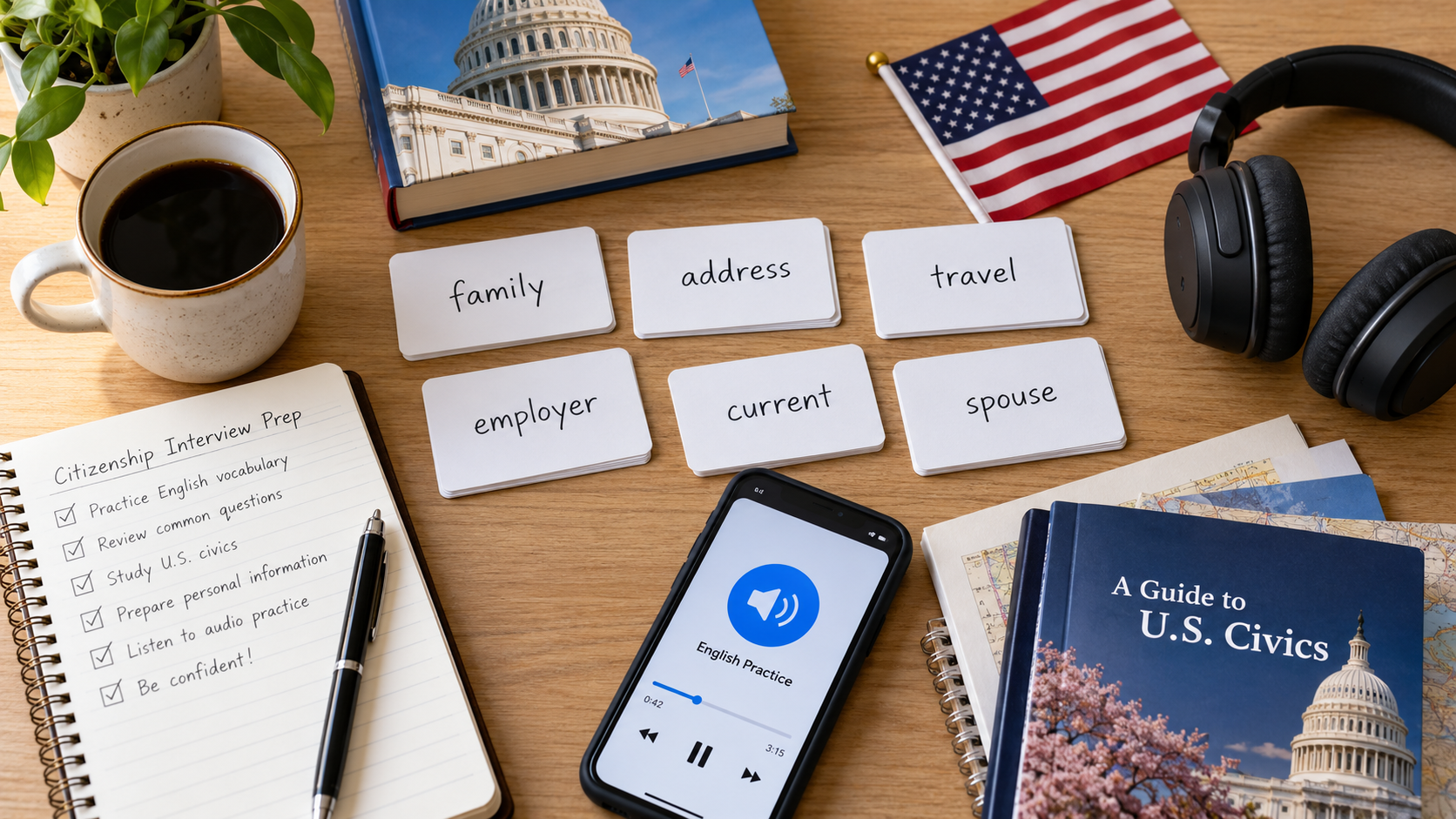
    Tarjetas con palabras de vocabulario en inglés, cuaderno de estudio, audífonos y materiales de preparación para la entrevista de ciudadanía estadounidense.

    CIVICSPREPUSA · PREPARACIÓN PARA LA ENTREVISTA DE CIUDADANÍA

    Aprende las palabras en inglés que pueden ayudarte durante tu entrevista de ciudadanía.

    Practica palabras sobre tu familia, trabajo, dirección, viajes, Formulario N-400 e instrucciones comunes de USCIS.

    Has estudiado las preguntas del examen de ciudadanía.

    Conoces datos sobre la historia y el gobierno de Estados Unidos.

    Pero durante tu entrevista de ciudadanía, el oficial de USCIS también puede hacerte preguntas sobre otros temas.

    Tu dirección.

    Tu trabajo.

    Tu familia.

    Tus viajes fuera de Estados Unidos.

    Tal vez conozcas toda esa información. Pero ¿qué pasa si no entiendes una palabra importante en inglés?

    Aprender palabras útiles en inglés puede ayudarte a entender mejor al oficial y a explicar tu información personal con más claridad.

    No necesitas memorizar todo un diccionario de inglés.

    Es mejor comenzar con las palabras que tienen relación con tu vida, tu Formulario N-400 y tu entrevista de naturalización.

    En CivicsPrepUSA, creemos que aprender palabras en grupos pequeños y practicarlas dentro de oraciones puede ayudarte a aprovechar mejor tu tiempo de estudio.

    Esta guía te ayudará a comenzar.

    Respuesta rápida: ¿Qué palabras en inglés debo estudiar?

    Antes de tu entrevista de ciudadanía, practica estos siete grupos de palabras:

    1. Palabras para hacer preguntas: What, where, when, who, why y how.
    2. Información personal: Name, birth, address y residence.
    3. Familia y trabajo: Spouse, married, employer y occupation.
    4. Tiempo y viajes: Before, after, since, during y outside.
    5. Instrucciones de la entrevista: Read, write, sign, wait y follow.
    6. Palabras importantes del formulario: Ever, never, prior y otras palabras que aparecen en las preguntas del Formulario N-400.
    7. Palabras de educación cívica: Government, Constitution, Congress y citizen.

    Estos grupos pueden ayudarte a estudiar. No son una lista completa de palabras que USCIS exige conocer.

    Lo más importante es entender las palabras cuando las escuchas y saber cómo responder con información verdadera.

    ¿Por qué es importante conocer palabras en inglés para la entrevista de ciudadanía?

    Durante la entrevista de naturalización, un oficial de USCIS revisa tu solicitud y te hace preguntas sobre tu vida y tus antecedentes.

    Los solicitantes que deben cumplir el requisito de inglés tienen que demostrar su capacidad para hablar, leer y escribir en ese idioma.

    USCIS evalúa la capacidad para hablar inglés por medio de las respuestas a las preguntas que normalmente se hacen durante la entrevista sobre el Formulario N-400.

    Las pruebas de lectura y escritura son partes separadas del examen de inglés.

    USCIS tiene listas oficiales de vocabulario para esas dos pruebas.

    También ofrece materiales para practicar palabras e instrucciones comunes de la entrevista.

    Estos recursos tienen diferentes propósitos.

    Conocer las palabras de la prueba de lectura no significa que ya conozcas todas las palabras que podrías escuchar durante tu entrevista sobre el Formulario N-400.

    Por eso, tu preparación debe incluir ejercicios para escuchar y hablar, no solamente para leer y memorizar.

    1. ¿Qué palabras para hacer preguntas debo conocer?

    Comienza con las palabras que se utilizan para hacer preguntas.

    Estas palabras pequeñas te ayudan a entender qué información quiere el oficial.

    Palabra en inglés Significado sencillo
    WhatQué: pide información
    WhereDónde: pregunta por un lugar
    WhenCuándo: pregunta por una fecha o un momento
    WhoQuién: pregunta por una persona
    WhyPor qué: pregunta por una razón
    HowCómo: pregunta de qué manera, en qué condición o en qué cantidad

    Ahora observa estas preguntas de práctica.

    What is your full name?

    ¿Cuál es tu nombre completo?

    El oficial quiere saber tu nombre.

    Where do you live?

    ¿Dónde vives?

    El oficial quiere saber dónde está tu hogar.

    When were you born?

    ¿Cuándo naciste?

    El oficial quiere saber tu fecha de nacimiento.

    Who is your employer?

    ¿Quién es tu empleador?

    El oficial quiere saber para quién trabajas.

    How long have you lived at your current address?

    ¿Cuánto tiempo llevas viviendo en tu dirección actual?

    El oficial quiere saber cuánto tiempo has vivido allí.

    Observa cómo estas palabras cambian la información que debes dar.

    Una fecha no es lo mismo que un lugar.

    El nombre de una persona no es lo mismo que una cantidad de tiempo.

    Practica la diferencia entre When y How long

    When did you move here?

    ¿Cuándo te mudaste aquí?

    Puedes responder con una fecha.

    “I moved here in 2022.”

    Me mudé aquí en 2022.


    How long have you lived here?

    ¿Cuánto tiempo llevas viviendo aquí?

    Puedes responder con una cantidad de tiempo.

    “I have lived here for four years.”

    Llevo cuatro años viviendo aquí.

    Las dos respuestas pueden hablar de la misma situación, pero responden a preguntas diferentes.

    Estos son ejemplos educativos. No significa que el oficial vaya a hacerte exactamente estas preguntas.

    2. ¿Qué palabras sobre mi información personal debo conocer?

    El oficial de USCIS puede revisar la información personal que escribiste en tu Formulario N-400.

    Es importante reconocer palabras relacionadas con tu identidad y el lugar donde vives.

    Palabra o expresión en inglés Significado
    Full nameNombre completo
    Given nameNombre de pila
    Family nameApellido
    Date of birthFecha de nacimiento
    Place of birthLugar de nacimiento
    Country of birthPaís de nacimiento
    Current addressDirección actual
    Previous addressDirección anterior
    ResidenceLugar donde vives
    Permanent residentPersona que tiene la condición de residente permanente legal

    Practica con tu propia información

    Intenta responder estas preguntas en voz alta.

    • “What is your full name?”
    • “What is your date of birth?”
    • “What country were you born in?”
    • “What is your current address?”
    • “Where did you live before?”

    Utiliza tus datos verdaderos.

    No memorices el nombre, la dirección ni las fechas de otra persona.

    Por ejemplo:

    “My name is Maria Lopez.”

    Me llamo María López.

    “I was born on March 12, 1985.”

    Nací el 12 de marzo de 1985.

    “I live in New Jersey.”

    Vivo en Nueva Jersey.

    Estas son respuestas de ejemplo.

    Durante tus prácticas debes utilizar tu información real.

    Aprende palabras que se relacionan

    En lugar de estudiar solamente la palabra “address”, aprende estas expresiones:

    • Current address: Dirección actual.
    • Previous address: Dirección anterior.
    • Home address: Dirección de tu casa.

    Después, practica una oración con cada expresión.

    Esto te ayuda a entender cómo se utiliza la palabra.

    3. ¿Qué palabras sobre la familia y el trabajo son útiles?

    El oficial también puede revisar información sobre tu familia y tus trabajos anteriores.

    Vocabulario sobre la familia

    Palabra en inglés Significado
    SpouseCónyuge: esposo o esposa
    MarriedCasado o casada legalmente
    SingleSoltero o soltera
    DivorcedDivorciado o divorciada
    WidowedViudo o viuda: su esposo o esposa falleció
    ChildHijo o hija
    DependentsPersonas que dependen de ti para recibir apoyo

    Preguntas para practicar:

    “Are you married?”

    ¿Estás casado o casada?

    “Do you have any children?”

    ¿Tienes hijos?

    “What is your marital status?”

    ¿Cuál es tu estado civil?

    Practica las respuestas que describen tu situación real.

    Vocabulario sobre el trabajo

    Palabra en inglés Significado
    EmploymentEmpleo o trabajo remunerado
    EmployerEmpleador: persona o empresa para la que trabajas
    OccupationOcupación: el tipo de trabajo que haces
    EmployedQue tiene empleo
    UnemployedQue actualmente no tiene empleo
    Self-employedQue trabaja por cuenta propia
    Previous employerPersona o empresa para la que trabajaste antes

    Preguntas para practicar:

    “Where do you work?”

    ¿Dónde trabajas?

    “What is your occupation?”

    ¿Cuál es tu ocupación?

    “Who is your employer?”

    ¿Quién es tu empleador?

    “Where did you work before?”

    ¿Dónde trabajabas antes?

    Tus respuestas deben describir tu verdadero historial de trabajo.

    Si trabajas por tu cuenta o has tenido varios empleos, practica cómo explicar tu situación usando un inglés sencillo y correcto.

    No necesitas inventar otro nombre para tu trabajo solo porque sea más fácil decirlo.

    4. ¿Por qué son tan importantes las palabras relacionadas con el tiempo?

    Algunas de las palabras más importantes de una entrevista no son nombres de personas ni lugares.

    Son palabras relacionadas con el tiempo.

    Palabra en inglés Significado común
    CurrentActual: lo que es cierto ahora
    PreviousAnterior
    PriorAntes de algo
    SinceDesde un momento determinado
    DuringDurante un período de tiempo
    BeforeAntes
    AfterDespués
    EverAlguna vez
    NeverNunca
    FrequentlyFrecuentemente, muchas veces
    HabituallyHabitualmente, por costumbre

    Estas palabras pueden cambiar el significado de una pregunta.

    Current y Previous

    “What is your current address?”

    ¿Cuál es tu dirección actual?

    Te preguntan dónde vives ahora.

    “What was your previous address?”

    ¿Cuál era tu dirección anterior?

    Te preguntan dónde vivías antes.

    Since y Before

    “Where have you worked since 2022?”

    ¿Dónde has trabajado desde 2022?

    La pregunta se refiere al período que comenzó en 2022.

    “Where did you work before 2022?”

    ¿Dónde trabajabas antes de 2022?

    La pregunta se refiere a un período anterior.

    Ever y Never

    La palabra ever es especialmente importante cuando revisas preguntas sobre tu pasado.

    “Have you ever…” pregunta si algo ocurrió alguna vez durante el período al que se refiere la pregunta completa.

    La palabra never significa que algo no ocurrió en ningún momento durante el período mencionado.

    Importante: No respondas una pregunta basándote solamente en una palabra. Escucha la pregunta completa, incluidas las fechas y cualquier límite de tiempo.

    Algunas preguntas del Formulario N-400 tienen significados legales importantes.

    Necesitas entender toda la pregunta, no solamente el significado común de sus palabras.

    Si no estás seguro de lo que significa una pregunta de tu solicitud, busca ayuda confiable antes de la entrevista.

    5. ¿Qué palabras sobre viajes debo practicar?

    USCIS puede revisar la información sobre tus viajes fuera de Estados Unidos.

    Estas palabras pueden ayudarte:

    • Travel: Viajar de un lugar a otro.
    • Trip: Viaje.
    • Departure: Salida de un lugar.
    • Return: Regreso.
    • Outside the United States: Fuera de Estados Unidos.
    • Passport: Pasaporte.
    • Duration: Duración; cuánto tiempo dura algo.
    • Date of departure: Fecha de salida.
    • Date of return: Fecha de regreso.

    Practica preguntas como estas:

    “Have you traveled outside the United States?”

    ¿Has viajado fuera de Estados Unidos?

    “When did you leave?”

    ¿Cuándo saliste?

    “When did you return?”

    ¿Cuándo regresaste?

    “How long were you outside the country?”

    ¿Cuánto tiempo estuviste fuera del país?

    Estas preguntas son ejemplos de práctica.

    El oficial puede hacerte preguntas diferentes, según la información de tu solicitud.

    Ejemplo de una conversación

    Officer: Have you traveled outside the United States?

    Applicant: Yes.

    Officer: Where did you go?

    Applicant: I went to Mexico.

    Officer: When did you return?

    Applicant: I returned in June.

    En español, esta conversación significa:

    Oficial: ¿Has viajado fuera de Estados Unidos?

    Solicitante: Sí.

    Oficial: ¿A dónde fuiste?

    Solicitante: Fui a México.

    Oficial: ¿Cuándo regresaste?

    Solicitante: Regresé en junio.

    Este ejemplo te ayuda a practicar cómo escuchar preguntas sobre viajes.

    No es una conversación que debas memorizar como si describiera tu vida.

    Utiliza tus fechas y datos verdaderos.

    6. ¿Qué instrucciones puedo escuchar durante mi entrevista?

    Durante una entrevista, el oficial no solamente hace preguntas.

    También puede darte instrucciones.

    USCIS ofrece una actividad oficial de práctica llamada Understanding Commands for the Naturalization Interview.

    En español, el título significa “Comprender las instrucciones durante la entrevista de naturalización”.

    Estos son ejemplos de ese tipo de práctica:

    Instrucción en inglés Qué debes entender
    Please be seated.Por favor, siéntate
    Please remain standing.Por favor, permanece de pie
    Please follow me.Por favor, sígueme
    Please wait here.Por favor, espera aquí
    Raise your right hand.Levanta la mano derecha
    Please hand me your passport.Por favor, entrégame tu pasaporte
    Please print your name.Escribe tu nombre con letra clara
    Sign your name here.Firma aquí
    Read this sentence.Lee esta oración en voz alta
    Write this sentence here.Escribe esta oración aquí

    Practica escuchando sin leer

    Pídele a otra persona que diga una instrucción en inglés.

    No mires la oración escrita.

    Escucha y demuestra que la entendiste.

    Por ejemplo:

    Si escuchas “Please be seated”, siéntate.

    Si escuchas “Please remain standing”, permanece de pie.

    Si escuchas “Please follow me”, entiende que debes acompañar a la persona.

    También puedes practicar con grabaciones de audio en casa.

    El objetivo es reconocer las palabras cuando alguien las dice de manera natural.

    7. ¿Qué palabras importantes del Formulario N-400 debo estudiar con más cuidado?

    Algunas palabras de los formularios de inmigración tienen significados importantes que no siempre son fáciles de entender.

    Entre ellas están:

    • Arrested.
    • Cited.
    • Charged.
    • Convicted.
    • Oath.
    • Swear.
    • Claim.
    • Register.
    • Taxes.
    • Exempt.
    • Prior.
    • Federal.

    Para estudiar el vocabulario básico:

    Arrested puede referirse a una persona que fue detenida por las autoridades.

    Charged puede referirse a una persona que fue acusada formalmente de una infracción o delito.

    Convicted puede referirse a una condena o decisión penal que tiene un significado legal específico.

    Cited puede referirse a recibir una citación o un aviso por una posible infracción.

    Swear puede significar hacer una promesa o declaración solemne bajo juramento.

    Federal se refiere al gobierno nacional.

    Exempt generalmente significa que una persona no tiene que cumplir una regla u obligación porque existe una excepción que le corresponde.

    Estas son explicaciones sencillas para aprender inglés.

    No son definiciones legales completas.

    Importante: No adivines las respuestas a preguntas legales

    Una palabra como “charged” o “convicted” puede tener un significado especial en las leyes de inmigración.

    Entender su significado básico en inglés no siempre es suficiente para saber cómo responder todas las preguntas del Formulario N-400.

    Lee la pregunta completa y sus instrucciones.

    Si no sabes si debes informar sobre algún incidente de tu pasado, o no entiendes cómo se aplica una pregunta a tu situación, considera pedir orientación a un abogado de inmigración o a un representante acreditado por el Departamento de Justicia de Estados Unidos.

    Siempre proporciona información verdadera y completa.

    El propósito de aprender estas palabras es entender las preguntas, no buscar maneras de evitarlas.

    8. ¿Qué palabras de educación cívica debo reconocer?

    La entrevista de ciudadanía también incluye preguntas de educación cívica para los solicitantes que deben presentar esa prueba.

    Estas palabras son útiles:

    Palabra en inglés Significado sencillo
    ConstitutionConstitución: la ley suprema del país
    GovernmentGobierno: el sistema que dirige un país
    CongressCongreso: el poder legislativo nacional de Estados Unidos
    PresidentPresidente: la persona que dirige el poder ejecutivo
    CitizenCiudadano: persona que tiene ciudadanía
    AmendmentEnmienda: cambio o adición a un documento legal, como la Constitución
    BranchRama o poder del gobierno
    RightsDerechos: libertades y protecciones legales
    VoteVotar: elegir mediante una votación

    Sin embargo, conocer el significado de estas palabras no es suficiente.

    También debes estudiar las preguntas oficiales de educación cívica y las respuestas aceptadas para la versión del examen que te corresponda.

    Para esta parte de tu preparación, utiliza los materiales oficiales de educación cívica de USCIS.

    9. ¿Cómo puedo recordar las palabras en inglés con más facilidad?

    Leer una palabra diez veces no siempre significa que podrás reconocerla cuando alguien la diga.

    Prueba este método de cuatro pasos de CivicsPrepUSA:

    LEE → ESCUCHA → EXPLICA → UTILIZA

    Paso 1 — LEE

    Mira la palabra escrita.

    Por ejemplo:

    Employer

    Léela con atención.

    Paso 2 — ESCUCHA

    Pídele a alguien que diga la palabra en voz alta.

    También puedes escuchar una grabación.

    Presta atención a cómo suena.

    Paso 3 — EXPLICA

    Explica el significado con palabras sencillas.

    Por ejemplo:

    “An employer is a person or business I work for.”

    Un empleador es una persona o empresa para la que trabajo.

    Paso 4 — UTILIZA

    Usa la palabra dentro de una oración.

    Por ejemplo:

    “My employer is a restaurant.”

    Mi empleador es un restaurante.

    Después, practica una pregunta:

    “Who is your employer?”

    ¿Quién es tu empleador?

    Este ejercicio te ayuda a relacionar la palabra con una situación real.

    También puedes leer nuestro artículo How to Improve Your English Listening for the U.S. Citizenship Interview, disponible en inglés, para practicar cómo escuchar y entender mejor las preguntas.

    10. Practica este ejercicio de vocabulario de cinco minutos

    Puedes hacer este ejercicio todos los días en casa.

    Minuto 1 — Elige cinco palabras

    Selecciona cinco palabras útiles.

    Por ejemplo:

    • Current.
    • Previous.
    • Employer.
    • Spouse.
    • Travel.

    Minuto 2 — Lee y pronuncia cada palabra

    Mira cada palabra.

    Dila en voz alta.

    Asegúrate de entender su significado básico.


    Minuto 3 — Escucha las palabras

    Pídele a otra persona que lea las palabras en un orden diferente.

    Intenta reconocerlas sin mirar la lista.


    Minuto 4 — Practica preguntas

    Utiliza las palabras dentro de preguntas sencillas.

    “What is your current address?”

    ¿Cuál es tu dirección actual?

    “Where did you work previously?”

    ¿Dónde trabajabas antes?

    “Who is your employer?”

    ¿Quién es tu empleador?

    “Have you traveled outside the United States?”

    ¿Has viajado fuera de Estados Unidos?

    Responde utilizando tu información verdadera.


    Minuto 5 — Revisa las palabras difíciles

    ¿Qué palabras te costó entender?

    Escríbelas.

    Practícalas de nuevo mañana.

    Aprender bien cinco palabras puede ser más útil que estudiar una lista muy larga sin entenderla.

    Este es un consejo de estudio de CivicsPrepUSA. No es un requisito oficial de USCIS.

    11. Practica una conversación corta de entrevista

    Aquí tienes un ejemplo para practicar inglés.

    Officer: Good morning. Please be seated.

    Applicant: Good morning. Thank you.

    Officer: What is your full name?

    Applicant: My name is Maria Lopez.

    Officer: What is your current address?

    Applicant: I live at 25 Oak Street.

    Officer: Are you currently employed?

    Applicant: Yes, I am.

    Officer: What is your occupation?

    Applicant: I work as a nursing assistant.

    Officer: Have you traveled outside the United States?

    Applicant: Yes, I have.

    Officer: Where did you go?

    Applicant: I visited my family in Mexico.

    ¿Qué significa esta conversación?

    El oficial saluda y le pide a la solicitante que se siente.

    Después, le pregunta:

    • Su nombre completo.
    • Su dirección actual.
    • Si tiene empleo.
    • Qué tipo de trabajo hace.
    • Si ha viajado fuera de Estados Unidos.
    • A dónde viajó.

    Esta conversación es un ejemplo educativo.

    No es una transcripción oficial de una entrevista de USCIS ni una lista de preguntas obligatorias.

    Observa las palabras importantes:

    • Current: Actual.
    • Employed: Con empleo.
    • Occupation: Ocupación.
    • Traveled: Viajó o ha viajado.
    • Outside: Fuera.
    • Visited: Visitó.

    No necesitas utilizar oraciones complicadas para practicar información básica.

    Pero tus respuestas deben ser correctas, responder a lo que el oficial pregunta e incluir suficiente información cuando sea necesario.

    12. ¿Qué hago si escucho una palabra en inglés que no entiendo?

    Durante la entrevista puedes escuchar una palabra que no hayas practicado.

    Primero, escucha con atención.

    Piensa en el resto de la pregunta.

    Si todavía no entiendes, puedes pedirle educadamente al oficial que repita o aclare la pregunta.

    Por ejemplo, practica estas expresiones:

    “Could you please repeat the question?”

    ¿Podría repetir la pregunta, por favor?

    “Could you please say that again?”

    ¿Podría decir eso otra vez, por favor?

    USCIS tiene procedimientos para evaluar si un solicitante puede entender y responder preguntas en inglés durante la entrevista.

    No debes esperar que el oficial te diga las respuestas correctas del examen de educación cívica ni que te ayude a contestarlo.

    Para obtener más consejos, lee nuestro artículo relacionado:

    What Should I Do If I Don’t Understand the USCIS Officer During My Citizenship Interview?

    Este artículo está disponible en inglés.

    Cinco errores comunes al estudiar vocabulario

    1. Memorizar palabras sin entenderlas

    Saber pronunciar una palabra no significa que entiendas su significado.

    Practica cómo utilizarla dentro de una oración.

    2. Estudiar solamente las preguntas de educación cívica

    Es importante estudiar educación cívica.

    Pero también necesitas prepararte para entender preguntas sobre tu solicitud y tu información personal.

    3. Ignorar las palabras pequeñas relacionadas con el tiempo

    Palabras como “ever”, “before”, “since” y “current” pueden cambiar el significado de una pregunta.

    Estúdialas con cuidado.

    4. Leer sin practicar cómo escuchar

    Durante la entrevista, el oficial hablará contigo.

    Practica escuchar palabras y oraciones en conversaciones normales.

    5. Memorizar las respuestas personales de otra persona

    Los ejemplos pueden ayudarte a aprender cómo formar oraciones.

    Pero debes practicar utilizando tu propia información.

    Nunca des una respuesta falsa solamente porque la memorizaste.

    Preguntas frecuentes

    ¿Necesito memorizar todas las palabras en inglés antes de mi entrevista de ciudadanía?

    No existe una lista corta que incluya todas las palabras que podrían utilizarse durante una entrevista de naturalización.

    Prepárate para entender las preguntas de tu Formulario N-400 y las instrucciones comunes de la entrevista.

    También utiliza las listas oficiales de USCIS para las pruebas de lectura y escritura.

    ¿USCIS tiene una lista oficial de vocabulario para la entrevista?

    USCIS ofrece actividades para practicar vocabulario de la entrevista de naturalización, como:

    • Vocabulary for the Naturalization Interview: Self-Test 1.
    • Vocabulary for the Naturalization Interview: Self-Test 2.

    También ofrece materiales separados con vocabulario para las pruebas de lectura y escritura en inglés.

    Estos recursos no significan que todas las entrevistas tengan exactamente las mismas palabras o preguntas.

    ¿El oficial me hará preguntas sobre mi Formulario N-400?

    Sí.

    El oficial revisa tu solicitud de naturalización y hace preguntas sobre tus antecedentes.

    Las preguntas específicas también pueden depender de tu situación personal.

    ¿Debo memorizar respuestas completas?

    Es útil practicar respuestas correctas sobre tu propia información.

    Pero no debes depender solamente de memorizar una conversación.

    Escucha cada pregunta y responde lo que realmente te están preguntando.

    ¿Puedo responder en inglés con oraciones cortas?

    USCIS evalúa tu capacidad para hablar y entender inglés durante la entrevista.

    Las palabras sencillas y las frases cortas pueden ser apropiadas cuando responden a la pregunta de manera clara y correcta.

    Algunas preguntas necesitan más información.

    Responde lo suficiente para contestar lo que el oficial te pide.

    ¿Qué pasa si califico para una exención del requisito de inglés?

    Algunos solicitantes pueden recibir una exención del examen de inglés por su edad y por el tiempo que han sido residentes permanentes legales.

    Otros pueden cumplir los requisitos para una excepción basada en una discapacidad.

    Las reglas dependen de la situación de cada solicitante.

    Consulta las instrucciones oficiales de USCIS antes de suponer que todos deben presentar las mismas pruebas de inglés.

    Practica palabras en inglés con CivicsPrepUSA

    Puedes comenzar hoy con solamente cinco palabras.

    Aprende qué significa cada una.

    Escúchala.

    Pronúnciala en voz alta.

    Úsala dentro de una oración sencilla.

    Después, practica cómo responder una pregunta sobre tu propia vida.

    En CivicsPrepUSA, puedes combinar ejercicios de inglés para escuchar y hablar con tu preparación para el examen de ciudadanía.

    Nuestras actividades educativas y prácticas con entrevistadores virtuales pueden ayudarte a acostumbrarte a escuchar preguntas y responder en voz alta.

    Estas son herramientas de estudio.

    No son exámenes oficiales de USCIS y no garantizan cómo será tu entrevista real.

    La idea más importante que debes recordar

    No necesitas conocer todas las palabras del idioma inglés. Necesitas prepararte para entender y responder las preguntas importantes de tu entrevista.

    Comienza con estos temas:

    • Palabras para hacer preguntas.
    • Información personal.
    • Familia y trabajo.
    • Fechas y viajes.
    • Instrucciones comunes.
    • Palabras importantes del Formulario N-400.
    • Vocabulario de educación cívica.

    Practica con este método:

    LEE → ESCUCHA → EXPLICA → UTILIZA

    Lee la palabra.

    Escucha cómo se pronuncia.

    Explica su significado.

    Utilízala dentro de una oración.

    Sobre todo, relaciona las palabras con tu información verdadera.

    Aprender vocabulario en inglés no es solamente una manera de prepararte para aprobar un examen.

    También te ayuda a comprender a la persona que te habla y a comunicar tus propias respuestas.

    Comienza con cinco palabras útiles. Practícalas bien. Después, aprende cinco más.

    Practica inglés y ciudadanía con CivicsPrepUSA

    Fuentes oficiales de USCIS

    Las siguientes fuentes son materiales oficiales del gobierno de Estados Unidos. Algunos documentos están disponibles solamente en inglés.

    1. USCIS — Naturalization: What to Expect. Información oficial sobre la entrevista de naturalización y las pruebas de inglés y educación cívica. Consultar el recurso oficial.
    2. USCIS — Vocabulary for the Naturalization Interview: Self-Test 1 (Teacher Guide). Material educativo sobre palabras relacionadas con la información personal, el trabajo, la residencia, la familia y los viajes. Consultar el PDF oficial.
    3. USCIS — Vocabulary for the Naturalization Interview: Self-Test 2 (Teacher Guide). Material adicional sobre palabras y expresiones relacionadas con el Formulario N-400 y la entrevista. Consultar el PDF oficial.
    4. USCIS — Understanding Commands for the Naturalization Interview (Teacher Guide). Material educativo con ejemplos de instrucciones comunes durante la entrevista. Consultar el PDF oficial.
    5. USCIS — Components of the Naturalization Test. Información sobre las pruebas de inglés hablado, lectura y escritura y sus recursos de estudio. Consultar el PDF oficial.
    6. USCIS — Scoring Guidelines for the U.S. Naturalization Test. Orientación oficial sobre la evaluación de la capacidad para hablar y entender inglés. Consultar el PDF oficial.
    7. USCIS — Policy Manual, Volume 12, Part E, Chapter 2. Manual oficial sobre las pruebas de inglés y educación cívica, incluidos los requisitos y las excepciones que pueden corresponder a ciertos solicitantes. Consultar el Manual de Políticas de USCIS.

    Nota educativa: Los grupos de vocabulario, las conversaciones de ejemplo y los ejercicios de este artículo son herramientas para estudiar. No reemplazan las instrucciones del Formulario N-400, los materiales oficiales de USCIS ni el asesoramiento legal de un profesional autorizado. Siempre proporciona información verdadera sobre tu situación personal.


  • What Should I Do If I Give the Wrong Answer During My Citizenship Interview?

    What Should I Do If I Give the Wrong Answer During My Citizenship Interview?

    CIVICSPREPUSA · CITIZENSHIP INTERVIEW PREPARATION

    One wrong answer does not automatically mean you failed your citizenship test. Learn what USCIS requires and how to recover your focus after a mistake.

    NOTICE → RESET → LISTEN → ANSWER

    You are sitting in front of a USCIS officer.

    The officer asks a citizenship question.

    You answer, but suddenly you realize your answer may be wrong.

    Your heart starts beating faster.

    You wonder, “Did I just fail my citizenship test?”

    One wrong civics answer does not automatically mean you failed.

    You can make some mistakes and still pass the civics test. The number of correct answers you need depends on which test version applies to you.

    At CivicsPrepUSA, we want you to understand the official rules and prepare for the moment when an answer does not go as planned.

    Quick Answer: What Should I Do If I Give a Wrong Answer?

    If you give an incorrect civics answer during your citizenship interview:

    • Stay calm and keep listening.
    • If the officer continues, focus on the next question.
    • Do not assume that one mistake means you failed.
    • Give clear, correct answers to the remaining questions.
    • Remember that USCIS decides your result using official testing procedures.

    If you think an answer was wrong, do not repeatedly interrupt or argue. Follow the officer’s instructions.

    For practice at home, use this simple CivicsPrepUSA method:

    NOTICE → RESET → LISTEN → ANSWER

    This is a CivicsPrepUSA study and confidence-building technique. It is not an official USCIS testing procedure.

    Does One Wrong Answer Mean I Failed the Citizenship Test?

    No. The standard civics test does not require every answer to be correct.

    USCIS uses different civics test versions based on when an applicant filed Form N-400.

    The 2025 Civics Test

    If you filed Form N-400 on or after October 20, 2025, the 2025 civics test generally applies.

    2025 Civics Test — Standard Rules

    • Official study bank: 128 questions.
    • Officer asks: up to 20 questions.
    • Correct answers needed to pass: 12.
    • Incorrect answers that result in failure: 9.

    The officer stops administering the civics test when you reach either 12 correct answers or 9 incorrect answers.

    This scoring procedure is confirmed in the September 18, 2025, Federal Register notice announcing implementation of the 2025 test.

    That means one incorrect answer does not end your test.

    The 2008 Civics Test

    If you filed Form N-400 before October 20, 2025, the 2008 civics test generally applies.

    2008 Civics Test — Standard Rules

    • Official study bank: 100 questions.
    • Officer asks: up to 10 questions.
    • Correct answers needed to pass: 6.
    • Incorrect answers that result in failure: 5.

    The officer stops when you reach 6 correct answers or 5 incorrect answers.

    Important: Special Testing Considerations

    Some applicants qualify for exemptions, disability waivers, or special civics testing rules. For example, eligible applicants age 65 or older who have been lawful permanent residents for at least 20 years may receive special consideration. The standard question counts above do not describe every applicant’s situation. Always check the official USCIS requirements that apply to you.

    What Happens Immediately After I Give an Incorrect Answer?

    The officer administers the test according to USCIS procedures.

    If you have not reached the passing or failing threshold, the test can continue with additional questions.

    Imagine this situation.

    The officer asks a question about Congress.

    You answer incorrectly.

    Then the officer asks a question about the Constitution.

    You know this next answer.

    But you are still thinking about your earlier mistake.

    Now you may lose focus on a question you actually know.

    The previous question is finished. Give your attention to the question in front of you.

    This is practical preparation advice. It is not a guarantee about how a particular interview will proceed.

    The Four-Step CivicsPrepUSA Recovery Method

    During practice, use this method when you give a wrong answer.

    NOTICE → RESET → LISTEN → ANSWER

    1. NOTICE

    Recognize that your answer may have been incorrect.

    Do not turn a single mistake into a judgment about your ability.

    One difficult question does not erase everything you have studied.

    During home practice, mark the question for later review.

    During the real interview, follow the officer’s instructions.

    2. RESET

    Bring your attention back to the present moment.

    Take a comfortable breath.

    Relax your shoulders if you feel tense.

    Tell yourself:

    “I will focus on the next question.”

    The goal is to prevent one mistake from interfering with the next answer.

    3. LISTEN

    Pay attention to the whole question.

    Do not start answering before you understand what is being asked.

    Listen for the main idea.

    Official civics question:

    “What is the highest court in the United States?”

    Important clue: highest court

    Correct answer: Supreme Court

    If you do not understand a question, you may politely ask the officer to repeat it. Do not assume that repetition, hints, or additional explanation will always be provided.

    4. ANSWER

    Give the correct information clearly.

    You do not need to turn every answer into a long explanation.

    USCIS publishes accepted answers in its official civics study materials.

    For example:

    Question: What is the highest court in the United States?

    Answer: Supreme Court.

    Clear. Correct. Finished.

    Practice saying answers aloud instead of only recognizing them when reading.

    Can I Correct My Answer After I Say It?

    Sometimes you give an answer and immediately realize you meant something else.

    You may feel that you need to stop and explain.

    However, do not assume that you have an automatic right to replace an answer after it has been given.

    If the officer is still addressing the question and you wish to clarify your response, you can try to do so briefly and respectfully.

    The officer determines how responses are evaluated under USCIS testing procedures.

    Do not argue or repeatedly interrupt to demand a different score.

    If the officer moves to another question, direct your attention to that question.

    During home practice, review why you remembered the correct answer too late. This can help you strengthen your recall.

    Why Do People Give Wrong Answers to Questions They Studied?

    There is more than one possible reason.

    Sometimes you do not know the information well enough.

    Sometimes you confuse two facts.

    Sometimes you answer before hearing the whole question.

    Sometimes the correct answer comes to mind a few seconds too late.

    For example, you might confuse:

    • The Senate and the House of Representatives.
    • The executive branch and the legislative branch.
    • The capital of a state and the capital of the United States.

    Each mistake requires a different kind of practice.

    If You Did Not Know the Answer

    Return to the official USCIS study material. Learn the fact and practice saying it aloud.

    If You Confused Two Answers

    Study the related facts together. Look at what makes them different.

    If You Answered Too Quickly

    Practice listening to the entire question before speaking.

    If You Remembered Too Late

    Practice remembering the answer without looking at your notes.

    For more help with delayed recall, read our related article:

    What Should I Do If I Know the Citizenship Answer but My Mind Goes Blank?

    Learn the Difference Between a Mistake and a Knowledge Gap

    After a practice session, ask yourself why each incorrect answer happened.

    • I knew it, but answered too fast. Practice listening carefully.
    • I confused two answers. Compare the facts side by side.
    • I did not know the answer. Study the official information.
    • I remembered it too late. Practice active recall.

    At CivicsPrepUSA, we encourage learners to use practice mistakes as information. The purpose is to find difficult questions before the real interview.

    Try the Five-Question Recovery Exercise

    This is a CivicsPrepUSA study activity. It is not an official USCIS testing procedure.

    Step 1 — Choose Five Questions

    Select five official USCIS civics questions from the test version that applies to you.

    Step 2 — Hear the First Question

    Ask someone to read it aloud or use an audio practice tool. Do not look at the answer.

    Step 3 — Answer Aloud

    Answer as you would during the real civics test.

    Step 4 — Check the Official Answer

    If you were correct, move forward.

    If you were incorrect, mark the question and identify the reason.

    Step 5 — Reset and Continue

    Move to the next question. Do not let the earlier mistake affect the rest of the exercise.

    After finishing all five questions, review the ones you missed.

    Hide the answers and try those questions again.

    Learn from the mistake, but do not carry it into the next question.

    A Simple 10-Minute Practice Routine

    Try adding this short exercise to your regular citizenship preparation.

    Minutes 1–2: Easy Questions

    Answer a few questions you already know.


    Minutes 3–5: Random Questions

    Mix the order and answer without looking.


    Minutes 6–8: Incorrect Answers

    Review the questions you missed and identify why.


    Minutes 9–10: Final Recall

    Try the missed questions again without looking at the answers.

    If you already follow our 15-minute citizenship study plan, you can include this exercise during part of your civics-review time.

    Revisit difficult questions later to see whether you can still remember the answers.

    What Happens If I Actually Fail the Civics Test?

    Failing the civics test is different from answering one question incorrectly.

    USCIS generally provides applicants two opportunities to pass the required English and civics tests for one naturalization application.

    If you fail a required portion of the test at your first examination, USCIS generally schedules another examination between 60 and 90 days after the first.

    You are retested only on the portion you failed.

    For example, if you pass the English test but fail civics, USCIS retests you on civics rather than repeating the English portion you passed.

    If you fail the required test again at the second examination, USCIS may deny your naturalization application based on that failure.

    These are official testing procedures described in USCIS naturalization guidance.

    To learn more about the testing process, visit the USCIS Naturalization: What to Expect page.

    Five Mistakes to Avoid

    1. Thinking One Incorrect Answer Means Failure

    Remember the official scoring rules. One incorrect answer does not automatically fail the test.

    2. Thinking About the Last Question Too Long

    Practice bringing your attention back to the question you are hearing now.

    3. Answering Before Listening Carefully

    Hear the complete question. Understand its meaning. Then answer.

    4. Practicing Only Easy Questions

    Questions you repeatedly miss deserve extra attention.

    5. Memorizing Without Speaking

    The civics test is oral. Practice hearing questions and answering them aloud.

    Frequently Asked Questions

    Can I still pass if I get one question wrong?

    Yes. Both standard civics test versions allow some incorrect answers. You must reach the correct-answer threshold for the version that applies to you.

    Will the officer ask another question if I answer incorrectly?

    The officer continues administering the civics test until you reach the applicable passing or failing threshold. Do not assume you will automatically get another chance to answer the same question.

    Can I change an answer after I say it?

    Do not assume you can automatically replace an answer. If you need to clarify something while the officer is still addressing the question, speak briefly and respectfully. The officer evaluates responses under USCIS procedures.

    Can I ask the officer to repeat a question?

    You may politely ask if you did not understand. However, do not assume the officer must repeat or explain every question, or provide hints.

    How many answers can I get wrong on the 2025 test?

    Under the standard 2025 civics test, you must answer 12 questions correctly to pass. Reaching 9 incorrect answers results in failure.

    What if I fail civics but pass English?

    USCIS generally retests you only on the failed civics portion during the second examination.

    Should I practice with random questions?

    Yes. Mixing questions is a useful CivicsPrepUSA study technique. It can help you remember information without depending on the order of your study materials.

    Practice With CivicsPrepUSA

    Knowing the correct answer matters.

    But learning how to respond after a mistake can also help you prepare.

    At CivicsPrepUSA, practice hearing questions, answering aloud, and reviewing difficult information.

    You can also use practice activities with different virtual officers to become familiar with different speaking voices.

    Virtual officers are educational tools. They are not actual USCIS officers and cannot guarantee how an interview will proceed.

    After each practice session, review the answers you missed.

    Find out why you missed them.

    Then try again.

    The Main Idea to Remember

    One wrong answer does not automatically mean you failed your citizenship test.

    Know the official rules for your test version. Practice clear answers. Review your mistakes.

    NOTICE → RESET → LISTEN → ANSWER

    Notice what happened. Reset your attention. Listen to the next question. Answer using the correct information you know.

    One mistake is one question. It does not have to control the next one.

    Practice Citizenship Questions at CivicsPrepUSA

    Official Sources

    1. USCIS — Study for the Test. Official USCIS study and testing information.
    2. USCIS — 128 Civics Questions and Answers (2025 Version). Official 2025 question-and-answer PDF.
    3. USCIS — 10 Steps to Naturalization. Official naturalization process guide.
    4. USCIS — Naturalization: What to Expect. Official interview and naturalization overview.
    5. Federal Register — Notice of Implementation of 2025 Naturalization Civics Test, September 18, 2025. Official government notice confirming the 2025 test and scoring procedures.

    Educational note: This article explains general USCIS testing information and CivicsPrepUSA study techniques. It is not legal advice. Applicants should follow current official USCIS instructions and check which requirements apply to their individual circumstances.

  • What Should I Do If I Know the Citizenship Answer but My Mind Goes Blank?

    What Should I Do If I Know the Citizenship Answer but My Mind Goes Blank?

    What Should I Do If I Know the Citizenship Answer but My Mind Goes Blank?

    You studied the question.

    You know the answer.

    You may have answered it many times before.

    But then you hear the question and suddenly your mind feels empty.

    This can happen during practice. It can also happen when you are nervous and trying hard to remember.

    If your mind goes blank, do not panic.

    Use this simple method:

    PAUSE → FIND THE CLUE → RECALL → ANSWER

    The goal is to help your brain find information that you already studied.

    Quick Answer

    If you know the answer but cannot remember it right away:

    PAUSE. Give yourself a brief moment.

    FIND THE CLUE. Listen for the important idea in the question.

    RECALL. Connect that clue with the answer you studied.

    ANSWER. Give a clear correct answer.

    For applicants taking the 2025 civics test, USCIS says the civics test is oral. The officer asks questions aloud from the official question bank. USCIS also encourages applicants to answer using the answers in its official study materials.

    That means your study time should include more than reading.

    You should practice:

    HEAR → REMEMBER → ANSWER

    Why Can Your Mind Go Blank Even When You Know the Answer?

    Knowing information and remembering it quickly are not exactly the same thing.

    When you study at home, you may have:

    – the question in front of you;
    – the answer nearby;
    – plenty of time;
    – a familiar voice; and
    – very little pressure.

    The real interview is different.

    A USCIS officer asks questions about your application and background. Applicants who must meet the testing requirements also take the English and civics tests unless an exemption or waiver applies.

    You may be thinking about many things at the same time.

    That can make a familiar answer harder to remember.

    This does not necessarily mean you never learned the answer.

    It means you should also practice bringing the answer back from memory.

    The Four-Step Recall Method

    When your mind goes blank, remember:

    PAUSE → FIND THE CLUE → RECALL → ANSWER

    1. PAUSE

    Do not immediately say the first thing that comes into your mind.

    Take a brief moment to think.

    Listen to the whole question.

    Your goal is not to answer as fast as possible.

    Your goal is to remember the correct information.

    2. FIND THE CLUE

    Look for the most important idea in the question.

    For example, one official 2025 USCIS question is:

    “What is the supreme law of the land?”

    A useful clue is:

    supreme law

    The official answer includes:

    the U.S. Constitution

    Now try another official question:

    “What is the highest court in the United States?”

    The clue is:

    highest court

    The answer is:

    Supreme Court

    You are teaching your brain to connect an important idea with the correct answer.

    Practice Finding Clues

    Here are more examples from the 2025 civics materials.

    Question: What are the two parts of the U.S. Congress?
    Clue: two parts of Congress
    Answer: Senate and House of Representatives.

    Question: The President of the United States is in charge of which branch of government?
    Clue: President + branch
    Answer: Executive branch.

    Question: What is the capital of the United States?
    Clue: U.S. capital
    Answer: Washington, D.C.

    Notice what we are doing.

    We are not changing the official questions.

    We are using a study technique to help you remember the answers.

    Practice:

    QUESTION → CLUE → ANSWER

    3. RECALL

    After you find the clue, try to remember the answer before looking at it.

    This is important.

    Do not immediately check your notes every time you forget something.

    Give your memory a chance first.

    At CivicsPrepUSA, we can describe this practice rule simply:

    Try first. Check second.

    If you remember the answer, say it aloud.

    If you cannot remember it, check the official answer.

    Then hide the answer and try the question again.

    Do not stop after reading the correct answer.

    Make yourself retrieve it one more time.

    Recognition Is Not the Same as Recall

    Imagine you see this question:

    What is the highest court in the United States?

    Then you see several possible choices.

    You might quickly recognize:

    Supreme Court

    Recognition is helpful.

    But the actual civics test is oral. USCIS says the officer asks the civics questions aloud. It is not administered as a multiple-choice test.

    So you also need this skill:

    Hear the question → remember the answer → say the answer

    That is recall.

    4. ANSWER

    When the answer comes back to you, say it clearly.

    You do not need to turn every civics answer into a long explanation.

    USCIS provides accepted answers with each official question and encourages applicants taking the 2025 test to respond using those answers.

    For example:

    Question: What is the highest court in the United States?

    Answer: Supreme Court.

    Clear.

    Correct.

    Finished.

    What If I Remember Only Part of the Answer?

    Sometimes your mind is not completely blank.

    You remember one part.

    Use that part as a clue.

    Consider this official question:

    “What are the two parts of the U.S. Congress?”

    Maybe you remember:

    Senate…

    but the second part disappears.

    Think:

    Congress → Senate + ?

    That connection may help you remember:

    House of Representatives

    This is why some information is useful to practice as connected pieces.

    Build Strong Memory Connections

    Try making simple connections such as:

    Congress → Senate + House

    President → executive branch

    Highest court → Supreme Court

    Supreme law → Constitution

    U.S. capital → Washington, D.C.

    These connections are a CivicsPrepUSA study method. They are not additional USCIS test questions.

    Their purpose is to make official information easier to retrieve from memory.

    What If I Recognize the Idea but Need a Moment?

    Do not let one difficult second convince you that you have forgotten everything.

    Listen to the question again in your mind.

    Find the subject.

    Ask yourself:

    “What fact is this question asking for?”

    Then try to retrieve that fact.

    For example:

    President + branch

    may help you recall:

    Executive branch

    Or:

    highest court

    may help you recall:

    Supreme Court

    Keep the process simple.

    Do Not Memorize Only Question Numbers

    Question numbers can help you organize your study materials.

    But do not make the number your main memory clue.

    You need to recognize the question and its meaning.

    For the 2025 civics test, USCIS uses a bank of 128 questions and the officer asks up to 20 of them. You need at least 12 correct answers to pass that version of the test.

    So instead of learning:

    Number → answer

    build:

    Meaning → answer

    Why Random Practice Can Help

    Imagine that every day you study:

    Question 1
    Question 2
    Question 3
    Question 4

    always in exactly the same order.

    Eventually, the order itself can begin helping you remember what comes next.

    But during your actual civics test, your task is to understand and answer the question the officer asks.

    So during practice, mix the questions.

    Start at different places.

    Return to older questions.

    Mix easy questions with difficult ones.

    This is a CivicsPrepUSA study technique, not a USCIS testing rule.

    The goal is:

    ANY QUESTION → RECALL → ANSWER

    Try the Five-Second Recall Drill

    Here is a simple study exercise.

    Step 1 — Choose 10 Questions

    Use official USCIS civics questions.

    Step 2 — Hide the Answers

    Do not read the answers first.

    Step 3 — Hear One Question

    Have someone read it aloud or use audio practice.

    Step 4 — Try to Recall

    Give yourself a few seconds to search your memory.

    Step 5 — Answer Aloud

    If you remember the answer, say it.

    Step 6 — Check

    Compare your answer with the official USCIS answer.

    Step 7 — Try Again

    If you forgot the answer, study it briefly.

    Then hide it and answer the question again.

    The important rule is:

    Do not finish with the answer in front of you.

    Finish by recalling it yourself.

    Keep a Weak-Question List

    Some questions will be easy.

    Others will keep causing problems.

    Make a small list of the questions that you repeatedly forget.

    Start with perhaps five.

    Practice those questions more often.

    For each one:

    HEAR

    FIND THE CLUE

    RECALL

    ANSWER

    Then return to it later.

    You do not need to spend the same amount of study time on every question.

    A Simple 10-Minute Recall Routine

    You can add this to your regular citizenship study.

    Minutes 1–2: Easy Recall

    Answer a few questions you already know.

    Minutes 3–5: Random Questions

    Mix the order.

    Do not look at the answers first.

    Minutes 6–8: Weak Questions

    Practice the questions that you often forget.

    Minutes 9–10: Final Recall

    Return to two or three difficult questions.

    Try them again without looking.

    If you already use our CivicsPrepUSA 15-minute citizenship study plan, you can use this recall exercise during part of your civics-review time.

    What If I Completely Forget an Answer?

    During practice, forgetting is useful information.

    It tells you which question needs more work.

    Check the official answer.

    Say it.

    Hide it.

    Then try again.

    During the actual civics test, listen carefully and give a correct answer if you can recall one.

    For applicants taking the 2025 civics test, the officer asks up to 20 questions, and the applicant must answer at least 12 correctly.

    This means your preparation should focus on building reliable recall across the official question bank.

    Do I Need a Long Answer?

    Not necessarily.

    Use the answers USCIS provides for the test version that applies to you.

    The official 2025 question-and-answer document includes accepted answers for the civics questions, and USCIS encourages applicants to respond using those answers.

    For example:

    Question: What is the supreme law of the land?

    Answer: The U.S. Constitution.

    You do not need to add a speech when the accepted answer already answers the question.

    Practice Saying Answers Out Loud

    Reading is useful.

    But USCIS describes the civics test as an oral test.

    So do not only think:

    “I know the answer.”

    Say it.

    Practice hearing the question.

    Practice retrieving the answer.

    Practice speaking the answer.

    That makes your study activity more similar to the task you will perform during the civics test.

    Use Different Voices During Practice

    You can also practice hearing questions from different speakers.

    This is not a USCIS requirement.

    It is a listening exercise.

    If you always hear the same recorded voice, you may become very familiar with that speaker.

    Hearing different voices and speaking styles can help you focus on the meaning of the question.

    This is one reason CivicsPrepUSA offers practice with different virtual officers.

    The virtual officers are study tools. They are not actual USCIS officers and do not reproduce every part of a naturalization interview.

    Five Mistakes to Avoid

    1. Looking at the Answer Too Quickly

    Try to remember first.

    Check second.

    2. Studying Only in One Order

    Mix the questions during some of your practice sessions.

    3. Reading Without Speaking

    The civics test is oral, so practice answering aloud.

    4. Spending Most of Your Time on Questions You Already Know

    Give extra practice to the questions you repeatedly forget.

    5. Making a Correct Short Answer Unnecessarily Complicated

    Learn the accepted answers in the official USCIS materials.

    Give the information the question asks for.

    Frequently Asked Questions

    What should I do if my mind goes blank?

    Use:

    PAUSE → FIND THE CLUE → RECALL → ANSWER

    Give yourself a brief moment. Find the important idea. Connect it to the fact you studied. Then answer.

    Should I guess?

    During practice, do not simply guess and move on.

    Check the official answer when necessary, then hide it and try again.

    The goal is to strengthen recall.

    Should I study questions in order?

    You can use the official order while learning, but also mix the questions during practice.

    That helps you practice recalling each answer from the meaning of the question.

    Should I say my answers aloud?

    Yes, that is useful practice because USCIS administers the civics test orally.

    Should I memorize long explanations?

    Use the official accepted answers for the civics-test version that applies to you.

    Some questions have one accepted answer. Others have several possible answers. USCIS publishes the accepted responses in its official study materials.

    What if I keep forgetting the same question?

    Put it on your weak-question list.

    Practice it again later instead of simply rereading it many times in one sitting.

    Practice With CivicsPrepUSA

    Good practice should prepare you for the moment when the answer comes quickly.

    It should also prepare you for the moment when it does not.

    When a question makes your mind go blank, practice:

    PAUSE

    FIND THE CLUE

    RECALL

    ANSWER

    Mix difficult questions back into your practice later.

    Use different voices.

    Answer aloud.

    Try before looking.

    The purpose is to build stronger recall of the official civics information.

    The Main Idea to Remember

    Knowing an answer is one skill.

    Bringing that answer back when you hear the question is another.

    Use:

    PAUSE → FIND THE CLUE → RECALL → ANSWER

    PAUSE for a brief moment.

    FIND THE CLUE in the question.

    RECALL the information connected to that clue.

    ANSWER clearly.

    USCIS administers the 2025 civics test orally, so your preparation should include hearing questions and answering them aloud.

    At CivicsPrepUSA, remember:

    Try first. Check second. Answer aloud.

    Sources

    U.S. Citizenship and Immigration Services — 128 Civics Questions and Answers (2025 Version)
    https://www.uscis.gov/sites/default/files/document/questions-and-answers/2025-Civics-Test-128-Questions-and-Answers.pdf

    USCIS — 2025 Civics Test Study Guide
    https://www.uscis.gov/sites/default/files/document/brochures/USCIS-2025-Civics-Test-Study-Guide.pdf

    USCIS — Naturalization: What to Expect
    https://my.uscis.gov/citizenship/what_to_expect

  • ¿Qué debo hacer si no entiendo al oficial de USCIS durante mi entrevista de ciudadanía?

    ¿Qué debo hacer si no entiendo al oficial de USCIS durante mi entrevista de ciudadanía?

    ¿Qué debo hacer si no entiendo al oficial de USCIS durante mi entrevista de ciudadanía?

    Tal vez conozcas bien la información de tu Formulario N-400. Quizás hayas estudiado inglés durante semanas.

    Pero durante la entrevista real de ciudadanía, puedes escuchar una pregunta que no entiendas.

    Tal vez el oficial hable más rápido de lo que esperabas. Quizás no conozcas una palabra. O tal vez estés nervioso y te cueste concentrarte.

    Si esto sucede, no adivines.

    Pídele al oficial que repita la pregunta. Escucha con atención. Asegúrate de entender qué información quiere el oficial. Después responde.

    USCIS explica que durante la entrevista de naturalización, un oficial hace preguntas sobre tu solicitud y tus antecedentes. Los solicitantes que deben cumplir con los requisitos de examen también toman las pruebas de inglés y educación cívica, a menos que califiquen para una excepción o exención.

    En CivicsPrepUSA, queremos que practiques más que las respuestas correctas. También debes practicar qué hacer cuando no entiendes una pregunta.

    Eso es lo que aprenderás en este artículo.

    Respuesta rápida

    Si no entiendes al oficial de USCIS, recuerda estos cinco pasos:

    PARA → PIDE ACLARACIÓN → ESCUCHA → CONFIRMA → RESPONDE

    PARA. No respondas antes de entender.

    PIDE ACLARACIÓN. Pide con respeto que el oficial repita o diga la pregunta de otra manera.

    ESCUCHA. Escucha toda la pregunta otra vez.

    CONFIRMA. Piensa qué información quiere el oficial.

    RESPONDE. Da una respuesta clara y verdadera.

    La guía de USCIS dice que los oficiales deben repetir y reformular las preguntas mientras determinan si un solicitante entiende inglés. USCIS también explica que un solicitante puede responder con palabras o frases sencillas cuando esas respuestas contestan correctamente la pregunta.

    ¿Por qué puede ser difícil entender una pregunta hablada?

    Leer inglés y escuchar inglés son habilidades diferentes.

    Cuando lees una oración, las palabras permanecen en la página. Puedes detenerte. Puedes volver a leerlas.

    Cuando alguien habla, las palabras desaparecen después de escucharlas.

    Durante la entrevista también puedes estar pensando en muchas cosas:

    – tu respuesta;
    – tus documentos;
    – tu pronunciación;
    – lo que el oficial puede preguntar después;
    – si estás cometiendo un error; y
    – los nervios.

    Todo esto puede hacer que una pregunta sencilla parezca más difícil.

    Esto es importante porque USCIS evalúa tu capacidad para hablar inglés durante la entrevista de elegibilidad del Formulario N-400.

    USCIS explica que la capacidad para hablar inglés se determina por las respuestas que das a las preguntas que normalmente se hacen durante esa entrevista.

    Por eso, no solo te estás preparando para conocer la información.

    También te estás preparando para:

    ESCUCHAR → ENTENDER → CONECTAR → RESPONDER

    El método de recuperación de cinco pasos

    Cuando no entiendas una pregunta, usa este método:

    PARA → PIDE ACLARACIÓN → ESCUCHA → CONFIRMA → RESPONDE

    1. PARA

    No te apresures a responder.

    Si no entendiste la pregunta, una respuesta rápida puede ser una respuesta a la pregunta equivocada.

    Tómate un momento.

    Tu primera tarea no es responder rápido.

    Tu primera tarea es entender.

    2. PIDE ACLARACIÓN

    Pídele al oficial que diga la pregunta otra vez.

    Puedes practicar frases sencillas como:

    “Could you please repeat the question?”

    “Could you say that again, please?”

    “I’m sorry. Could you repeat that?”

    Si escuchaste la pregunta pero no entendiste la forma en que fue expresada, también puedes practicar:

    “Could you say that another way, please?”

    Estas son frases de práctica. USCIS no exige que uses exactamente estas oraciones.

    La idea importante es sencilla:

    Si no entiendes, no finjas que entiendes.

    La guía de USCIS dice que los oficiales repiten y reformulan las preguntas mientras evalúan si un solicitante entiende inglés.

    3. ESCUCHA

    Cuando el oficial haga la pregunta otra vez, escucha toda la pregunta.

    No te concentres solamente en la palabra que no entendiste.

    Escucha las palabras que te indican qué tipo de información se está pidiendo.

    Who? — una persona

    What? — información o una acción

    When? — una fecha o un momento

    Where? — un lugar

    Why? — una razón

    How? — la manera en que ocurrió algo u otro tipo de información

    También escucha temas que reconozcas de tu Formulario N-400.

    El oficial puede preguntar sobre:

    – tu nombre;
    – tu dirección;
    – tu fecha de nacimiento;
    – tu familia;
    – tu trabajo;
    – tus viajes;
    – tu historial de inmigración; u
    – otra información de tu solicitud.

    Tu objetivo es identificar el tema principal de la pregunta.

    4. CONFIRMA

    Antes de responder, pregúntate:

    “¿Qué información quiere el oficial?”

    Imagina que el oficial pregunta:

    “When did you begin living at your current address?”

    Quizás no entiendas toda la oración la primera vez.

    Escucha otra vez.

    Tal vez reconozcas estas ideas:

    when + living + current address

    Ahora sabes que el oficial quiere saber cuándo comenzaste a vivir en tu dirección actual.

    No necesitas repetir la pregunta palabra por palabra.

    Necesitas entender qué información está pidiendo el oficial.

    Esto se conecta con el método de nuestra lección anterior de CivicsPrepUSA:

    ESCUCHA → SIGNIFICADO → INFORMACIÓN → RESPONDE

    Este artículo agrega otra habilidad:

    ¿Qué haces cuando todavía no entiendes?

    5. RESPONDE

    Cuando entiendas la pregunta, responde de forma clara y verdadera.

    No hagas tu inglés más complicado de lo necesario.

    USCIS dice que un solicitante puede responder con palabras o frases sencillas cuando esas respuestas contestan correctamente la pregunta.

    Por ejemplo, si el oficial pregunta:

    “Where do you live now?”

    no necesitas dar una explicación larga.

    Da la información que el oficial pidió.

    El objetivo es comunicarte con claridad.

    ¿Cuál es la diferencia entre repetir y reformular?

    Estas palabras son importantes.

    REPETIR significa hacer la pregunta otra vez con las mismas palabras o casi las mismas.

    REFORMULAR significa pedir la misma información de otra manera.

    Por ejemplo:

    Primera versión:
    “What is your current residence?”

    Otra manera:
    “Where do you live now?”

    Estos son solamente ejemplos de práctica. No significa que un oficial de USCIS vaya a usar exactamente estas frases.

    Repetir puede ayudarte si simplemente no escuchaste bien la pregunta.

    Reformular puede ayudarte si las palabras o la forma de la oración fueron difíciles de entender.

    Dicho de una manera más sencilla:

    Reformular significa decir la misma pregunta de otra manera.

    USCIS usa los conceptos de repetir y reformular en su guía de evaluación.

    ¿Qué pasa si entiendo la mayor parte de la pregunta?

    No siempre necesitas entender cada palabra.

    Trata de entender la idea principal.

    Imagina que escuchas:

    “How long have you lived at your present address?”

    Tal vez no conozcas la palabra present.

    Pero entiendes:

    how long + lived + address

    Eso puede ayudarte a entender que el oficial pregunta cuánto tiempo has vivido en tu dirección actual.

    Por eso debes practicar el significado, no solamente la memorización.

    No te preguntes solamente:

    “¿Entendí cada palabra?”

    También pregúntate:

    “¿Entiendo qué información quiere el oficial?”

    ¿Qué pasa si una palabra me confunde?

    Una palabra difícil puede hacer que dejes de escuchar.

    Trata de no permitir que eso suceda.

    Escucha las otras palabras de la oración.

    Después pregúntate si entiendes la pregunta en general.

    USCIS dice que la capacidad para entender inglés se evalúa por la manera en que el solicitante responde a preguntas, instrucciones o indicaciones durante la entrevista.

    USCIS también dice que el oficial no evalúa la comprensión pidiendo al solicitante que dé la definición de una palabra o frase del Formulario N-400.

    Eso no significa que el vocabulario no sea importante.

    Significa que estás usando el inglés para comunicarte, no para dar definiciones de diccionario.

    No adivines “Sí” o “No”

    Esto es muy importante.

    Si no entiendes una pregunta, no respondas automáticamente:

    “Yes.”

    o:

    “No.”

    Primero asegúrate de entender lo que preguntó el oficial.

    El oficial está revisando información relacionada con tu solicitud de naturalización.

    Si no entiendes, pide escuchar la pregunta otra vez.

    Después responde con la verdad.

    Una buena regla es:

    Primero entiende. Después responde.

    Tu Formulario N-400 es una herramienta importante de estudio

    USCIS dice que durante la entrevista de naturalización, el oficial hace preguntas sobre tu solicitud y tus antecedentes.

    También evalúa tu capacidad para hablar inglés mediante las respuestas que das durante la entrevista de elegibilidad del Formulario N-400.

    Por eso debes revisar tu propio Formulario N-400 antes de la entrevista.

    No practiques solamente preguntas generales de inglés.

    Practica hablar sobre tu propia información.

    Por ejemplo:

    – tu nombre;
    – tu dirección;
    – tu familia;
    – tu trabajo;
    – tus viajes; y
    – otra información que diste a USCIS.

    Conoce la información que pusiste en tu solicitud.

    Prepárate para responder con la verdad.

    Los materiales educativos de USCIS también incluyen habilidades relacionadas con el Formulario N-400 y la entrevista de naturalización.

    No todo lo que dice el oficial es una pregunta

    El oficial también puede darte instrucciones.

    USCIS evalúa si el solicitante puede responder correctamente a preguntas, instrucciones o indicaciones durante la entrevista.

    Por eso, tu práctica de comprensión auditiva también debe incluir instrucciones sencillas.

    Por ejemplo:

    “Please be seated.”

    “Raise your right hand.”

    “Show me your identification.”

    Estos son ejemplos de práctica. No son una lista de instrucciones exactas que todos los solicitantes escucharán.

    La habilidad es:

    ESCUCHA → ENTIENDE → RESPONDE

    Prueba este ejercicio para pedir aclaración

    Puedes practicar con un amigo, maestro, familiar o compañero de estudio.

    Paso 1 — Elige un tema

    Elige algo de tu Formulario N-400.

    Por ejemplo:

    Tu dirección actual

    Paso 2 — Escucha una pregunta

    Pide a tu compañero que diga:

    “What is your current address?”

    Paso 3 — Pide que repita

    Aunque hayas entendido, practica diciendo:

    “Could you please repeat the question?”

    Paso 4 — Escucha otra vez

    Pide a tu compañero que repita la pregunta.

    Paso 5 — Cambia las palabras

    Ahora pídele que pregunte:

    “Where do you live now?”

    Paso 6 — Identifica la información

    Pregúntate:

    “¿Qué información quiere esta persona?”

    Respuesta:

    Mi dirección actual.

    Paso 7 — Responde en voz alta

    Da tu respuesta.

    Este ejercicio te ayuda a practicar dos habilidades:

    pedir ayuda cuando no entiendes

    y

    entender la misma idea cuando cambian las palabras

    También puedes usar CivicsPrepUSA para practicar preguntas habladas.

    Escuchar diferentes voces puede ayudarte a depender menos de una sola forma de hablar.

    Una rutina sencilla de práctica de 10 minutos

    No necesitas una sesión larga.

    Prueba esto:

    Minutos 1–2: Repasa

    Elige una parte de tu Formulario N-400.

    Minutos 3–4: Escucha

    Escucha preguntas sobre esa información.

    Minutos 5–6: Pide aclaración

    Practica cómo pedir que repitan o aclaren una pregunta.

    Minutos 7–8: Cambia las palabras

    Practica escuchar la misma información expresada de diferentes maneras.

    Minutos 9–10: Responde

    Responde otra vez en voz alta las preguntas más difíciles.

    Si ya usas nuestro plan de estudio de ciudadanía de 15 minutos, puedes usar este ejercicio durante parte de tu práctica de comprensión auditiva.

    No practiques solamente cuando todo sale bien.

    También practica qué hacer cuando no entiendes.

    Cinco errores que debes evitar

    1. Adivinar porque estás nervioso

    Si no entendiste la pregunta, adivinar puede hacer que respondas algo diferente de lo que el oficial preguntó.

    Pide escucharla otra vez.

    2. Decir “sí” o “no” demasiado rápido

    Primero entiende a qué estás respondiendo.

    3. Memorizar solamente una versión de la pregunta

    No dependas de escuchar una sola oración exacta.

    USCIS dice que los oficiales repiten y reformulan preguntas mientras evalúan la comprensión del inglés.

    Practica el significado.

    4. Practicar solamente leyendo

    Leer es útil.

    Pero la entrevista de naturalización incluye comunicación oral.

    USCIS determina la capacidad para hablar inglés mediante las respuestas del solicitante durante la entrevista de elegibilidad del Formulario N-400.

    También debes practicar escuchar y responder en voz alta.

    5. Hacer tu respuesta demasiado complicada

    No necesitas hacer que una respuesta sencilla suene avanzada.

    USCIS permite palabras o frases sencillas cuando responden correctamente a la pregunta.

    Mantén tu respuesta clara.

    ¿Pedir que repitan una pregunta significa que fallé?

    Pedir que repitan una pregunta no significa automáticamente que fallaste.

    La guía de USCIS dice que los oficiales deben repetir y reformular preguntas mientras determinan si el solicitante entiende inglés.

    Pero hay una diferencia importante.

    USCIS todavía está evaluando si puedes entender y responder en inglés en general.

    Por eso, no te asustes porque necesitaste que repitieran una pregunta.

    Escucha otra vez.

    Trata de entender.

    Después responde.

    ¿Qué pasa si todavía no entiendo?

    Escucha la idea principal.

    Escucha información que te resulte familiar.

    Pregúntate:

    ¿Quién?

    ¿Qué?

    ¿Cuándo?

    ¿Dónde?

    ¿Por qué?

    ¿Cómo?

    Si el oficial hace la pregunta de otra manera, escucha con atención las nuevas palabras.

    Trata de conectar la pregunta con tu Formulario N-400.

    No inventes una respuesta solamente para que la entrevista continúe.

    Algunos solicitantes pueden calificar para una excepción o exención relacionada con los requisitos de inglés o educación cívica.

    Las reglas dependen de la situación de cada solicitante. Usa la información actual de USCIS si crees que una excepción puede aplicarse a ti.

    ¿Es esto lo mismo que el examen de educación cívica?

    No.

    La entrevista del Formulario N-400 y el examen de educación cívica son partes del proceso de naturalización, pero no son lo mismo.

    Durante la entrevista de naturalización, el oficial hace preguntas sobre tu solicitud y tus antecedentes.

    Los solicitantes que deben cumplir con los requisitos de examen también toman las pruebas de inglés y educación cívica.

    Este artículo trata principalmente sobre cómo entender al oficial durante la entrevista de elegibilidad del Formulario N-400.

    Para la parte de educación cívica, estudia los materiales oficiales de USCIS que correspondan al examen que te aplica.

    Los oficiales virtuales de CivicsPrepUSA pueden ayudarte a practicar preguntas de educación cívica con diferentes voces y estilos de presentación.

    Esa práctica de comprensión auditiva puede ser útil.

    Pero nuestros oficiales virtuales no son un simulador completo de la entrevista del Formulario N-400.

    Preguntas frecuentes

    ¿Puedo pedirle al oficial de USCIS que repita una pregunta?

    Sí.

    Puedes decirle al oficial que necesitas escuchar la pregunta otra vez.

    La guía de USCIS dice que los oficiales deben

  • What Should I Do If I Don’t Understand the USCIS Officer During My Citizenship Interview?

    What Should I Do If I Don’t Understand the USCIS Officer During My Citizenship Interview?

    You may know the information on your Form N-400. You may have studied English for weeks.

    But during your real citizenship interview, you may hear a question that you do not understand.

    Maybe the officer speaks faster than you expected. Maybe you do not know one word. Maybe you are nervous.

    If this happens, do not guess.

    Ask the officer to say the question again. Listen carefully. Make sure you understand what information the officer wants. Then answer.

    USCIS says that during the naturalization interview, an officer asks questions about your application and background. Applicants who must meet the testing requirements also take the English and civics tests unless an exception or waiver applies.

    Source: USCIS — Naturalization: What to Expect

    At CivicsPrepUSA, we want you to practice more than correct answers. You should also practice what to do when you do not understand a question.

    That is the skill we will practice here.

    Quick Answer

    If you do not understand the USCIS officer, remember these five steps:

    STOP → ASK → LISTEN → CONFIRM → ANSWER

    STOP. Do not answer before you understand.

    ASK. Politely ask the officer to repeat or rephrase the question.

    LISTEN. Listen to the full question again.

    CONFIRM. Think about what information the officer wants.

    ANSWER. Give a clear and truthful answer.

    USCIS guidance says officers are required to repeat and rephrase questions until they are satisfied that an applicant understands the question or does not understand English.

    USCIS also says an applicant may answer with simple words or phrases when those words correctly answer the question.

    Source: USCIS — Scoring Guidelines for the U.S. Naturalization Test

    Why Can a Spoken Question Be Hard to Understand?

    Reading English and listening to English are different skills.

    When you read a sentence, the words stay on the page. You can stop. You can look at them again.

    When someone speaks, the words are gone as soon as you hear them.

    During your interview, you may also be thinking about many things:

    • your answer;
    • your documents;
    • your pronunciation;
    • what the officer may ask next;
    • whether you are making a mistake; and
    • how nervous you feel.

    All of this can make a simple question feel harder.

    This matters because USCIS checks your speaking ability during the Form N-400 eligibility interview.

    Your speaking ability is based on how you answer questions the officer normally asks during that interview.

    Source: USCIS — Components of the Naturalization Test

    So you are not only preparing to know the information.

    HEAR → UNDERSTAND → CONNECT → ANSWER

    The Five-Step Recovery Method

    When you do not understand a question, use this method:

    STOP → ASK → LISTEN → CONFIRM → ANSWER

    1. STOP

    Do not rush to answer.

    If you did not understand the question, a quick answer may be an answer to the wrong question.

    Take a moment.

    Your first job is not to answer quickly.

    Your first job is to understand.

    2. ASK

    Politely ask the officer to say the question again.

    Here are some simple phrases you can practice:

    “Could you please repeat the question?”

    “Could you say that again, please?”

    “I’m sorry. Could you repeat that?”

    If you heard the question but did not understand the words, you can also practice:

    “Could you say that another way, please?”

    These are practice phrases. USCIS does not require you to use these exact sentences.

    The important idea is simple:

    If you do not understand, do not pretend that you do.

    USCIS guidance says officers repeat and rephrase questions while checking whether an applicant understands English.

    Source: USCIS Scoring Guidelines

    3. LISTEN

    When the officer asks again, listen to the whole question.

    Do not think only about the one word you missed.

    Listen for question words.

    Who? — a person

    What? — information or an action

    When? — a date or time

    Where? — a place

    Why? — a reason

    How? — the way something happened or another kind of information

    Also listen for subjects you know from your Form N-400.

    The officer may ask about:

    • your name;
    • your address;
    • your date of birth;
    • your family;
    • your work;
    • your travel;
    • your immigration history; or
    • other information on your application.

    Your goal is to find the main subject of the question.

    4. CONFIRM

    Before you answer, ask yourself:

    “What information does the officer want?”

    Imagine the officer asks:

    “When did you begin living at your current address?”

    You may not understand the whole sentence the first time.

    Listen again.

    Maybe you hear these important ideas:

    when + living + current address

    Now you know the officer wants information about when you started living there.

    You do not need to repeat the officer’s sentence word for word.

    You need to understand what the officer is asking.

    This connects with the method from our previous CivicsPrepUSA lesson:

    LISTEN → MEANING → INFORMATION → ANSWER

    What should you do when you still do not understand?

    5. ANSWER

    Once you understand the question, answer clearly and truthfully.

    Do not make your English harder than it needs to be.

    USCIS says an applicant may use simple words or phrases when those words properly answer the officer’s question.

    Source: USCIS Scoring Guidelines

    For example, if the officer asks:

    “Where do you live now?”

    You do not need to give a long speech.

    Give the information the officer asked for.

    Clear communication is the goal.

    What Is the Difference Between Repeat and Rephrase?

    These words are important.

    REPEAT means asking the question again with the same or almost the same words.

    REPHRASE means asking for the same information in another way.

    First version:
    “What is your current residence?”

    Another way:
    “Where do you live now?”

    These are only practice examples. They are not a promise that a USCIS officer will use these exact words.

    Repeating can help if you simply did not hear the question.

    Rephrasing can help if the words or sentence were difficult to understand.

    USCIS uses both terms in its official scoring guidance.

    Source: USCIS Scoring Guidelines

    What If I Understand Most of the Question?

    You do not always need to understand every single word.

    Try to understand the main idea.

    Imagine you hear:

    “How long have you lived at your present address?”

    Maybe you do not know the word present.

    But you understand:

    how long + lived + address

    You may still understand that the officer is asking how long you have lived at your current address.

    This is why you should practice meaning, not only memorization.

    Do not ask yourself only:

    “Did I understand every word?”

    Also ask:

    “Do I understand what information the officer wants?”

    What If One Word Confuses Me?

    One difficult word can make you stop listening.

    Try not to let that happen.

    Listen to the other words around it.

    Then ask yourself whether you understand the question as a whole.

    USCIS says your ability to understand English is based on whether you respond to questions, directions, or prompts during the interview.

    USCIS also says the officer does not test your understanding by asking you to give a definition of a word or phrase from Form N-400.

    Source: USCIS Scoring Guidelines

    That does not mean vocabulary is unimportant.

    It means you are using English to communicate, not to give dictionary definitions.

    Do Not Guess “Yes” or “No”

    This is very important.

    If you do not understand a question, do not automatically answer:

    “Yes.”

    or

    “No.”

    First make sure you understand what the officer asked.

    The officer is reviewing information connected to your naturalization application.

    If you do not understand, ask to hear the question again.

    Then answer truthfully.

    Understand first. Answer second.

    Your Form N-400 Is an Important Study Tool

    USCIS says the officer asks questions about your application and background during the naturalization interview.

    USCIS also says the officer reviews Form N-400 for accuracy during the eligibility interview.

    Sources: Naturalization: What to Expect and USCIS Scoring Guidelines

    That is why you should review your own Form N-400 before your interview.

    Do not practice only general English questions.

    Practice talking about your information.

    • your name;
    • your address;
    • your family;
    • your work;
    • your travel; and
    • other information you gave USCIS.

    Know what you put on your application.

    Be ready to answer truthfully about it.

    USCIS citizenship education materials also include Form N-400 interview skills as part of naturalization preparation.

    Source: USCIS — Guide to the Adult Citizenship Education Content Standards and Foundation Skills

    Not Everything the Officer Says Is a Question

    The officer may also give you directions.

    USCIS says understanding English includes responding to questions, directions, or prompts during the naturalization interview.

    Source: USCIS Scoring Guidelines

    So your listening practice should include simple directions too.

    “Please be seated.”

    “Raise your right hand.”

    “Show me your identification.”

    These are practice examples. They are not a list of exact instructions that every applicant will hear.

    HEAR → UNDERSTAND → RESPOND

    Try This Clarification Practice Drill

    You can practice this with a friend, teacher, family member, or study partner.

    Step 1 — Choose One Topic

    Choose something from your Form N-400. For example: your current address.

    Step 2 — Hear a Question

    “What is your current address?”

    Step 3 — Ask for Repetition

    “Could you please repeat the question?”

    Step 4 — Listen Again

    Have your partner repeat the question.

    Step 5 — Change the Wording

    “Where do you live now?”

    Step 6 — Find the Information

    What information does this person want?

    Answer: My current address.

    Step 7 — Answer Aloud

    Give your answer.

    This drill teaches you two useful skills:

    • asking for help when you do not understand; and
    • understanding the same idea when the words change.

    Practice with CivicsPrepUSA

    You can use our spoken-question practice to hear different voices and delivery styles. This can help you become less dependent on one familiar speaker.

    Open the free CivicsPrepUSA citizenship practice tools →

    A Simple 10-Minute Practice Routine

    Minutes 1–2: Review

    Choose one part of your Form N-400.

    Minutes 3–4: Listen

    Hear questions about that information.

    Minutes 5–6: Ask

    Practice asking for repetition or clarification.

    Minutes 7–8: Change the Words

    Practice hearing similar information asked in more than one way.

    Minutes 9–10: Answer

    Answer the difficult questions aloud again.

    If you already use our 15-minute citizenship study plan, you can use this exercise during part of your listening practice.

    Do not practice only when everything goes perfectly.

    Also practice what to do when you do not understand.

    Five Mistakes to Avoid

    1. Guessing Because You Feel Nervous

    If you did not understand the question, guessing may lead you to answer the wrong question. Ask to hear it again.

    2. Saying “Yes” or “No” Too Quickly

    First understand what you are saying yes or no to.

    3. Memorizing Only One Sentence

    Do not depend on hearing one exact sentence. USCIS guidance says officers repeat and rephrase questions while checking an applicant’s understanding of English.

    4. Practicing Only by Reading

    Reading is useful. But the naturalization interview is spoken.

    USCIS determines speaking ability from the applicant’s answers to questions during the Form N-400 eligibility interview.

    Source: USCIS — Components of the Naturalization Test

    You also need to practice listening and answering aloud.

    5. Making Your Answer Too Complicated

    You do not need to make a simple answer sound advanced. USCIS says simple words or phrases can be acceptable when they properly answer the question. Keep your answer clear.

    Does Asking the Officer to Repeat a Question Mean I Failed?

    Asking for repetition does not automatically mean that you failed.

    USCIS guidance says officers are required to repeat and rephrase questions while deciding whether an applicant understands English.

    USCIS is still checking whether you can generally understand and respond in English.

    Source: USCIS Scoring Guidelines

    So do not panic because you needed one question repeated.

    Listen again. Try to understand. Then answer.

    What If I Still Do Not Understand?

    Listen for the main idea.

    Listen for familiar information and ask yourself:

    Who?

    What?

    When?

    Where?

    Why?

    How?

    If the officer says the question another way, listen carefully to the new words.

    Try to connect the question with your Form N-400.

    Do not invent an answer just to keep the interview moving.

    Some applicants may qualify for an exception or waiver from part of the English or civics requirements. The rules depend on the applicant’s situation, so use current USCIS information if you think an exception may apply to you.

    Is This the Same as the Civics Test?

    No.

    The Form N-400 interview and the civics test are parts of the naturalization process, but they are not the same thing.

    During the naturalization interview, the officer asks questions about your application and background. Applicants who must meet the testing requirements also take English and civics tests.

    Source: USCIS — Naturalization: What to Expect

    This article is mainly about understanding the officer during the Form N-400 eligibility interview.

    For the civics test, study the official USCIS materials for the test that applies to you.

    CivicsPrepUSA’s virtual officers can help you practice hearing civics questions in different voices and delivery styles.

    That listening practice can be useful, but our civics officers are not a complete Form N-400 interview simulator.

    Frequently Asked Questions

    Can I Ask the USCIS Officer to Repeat a Question?

    Yes. You can tell the officer when you need to hear the question again. USCIS guidance says officers are required to repeat and rephrase questions while checking whether an applicant understands English.

    Can the Officer Ask the Question Another Way?

    Yes. USCIS guidance provides for officers to rephrase questions while testing understanding. The example phrases in this article are for practice. You do not need to memorize them word for word.

    Do I Need to Answer in a Full Sentence?

    Not always. USCIS says applicants may answer with simple words or phrases when those words properly answer the question.

    What If I Know the Answer but Do Not Understand the Question?

    Do not guess. Ask to hear the question again.

    LISTEN → CONFIRM → ANSWER

    Should I Memorize Interview Questions?

    It is useful to practice common questions and vocabulary. But do not depend only on memorizing one exact sentence. The officer reviews your real Form N-400 and asks questions about your application and background. Your answers need to come from your own information.

    What Else Should I Practice?

    • listening to spoken English;
    • asking for repetition;
    • hearing questions in different ways;
    • listening for directions;
    • finding the main idea;
    • reviewing your Form N-400; and
    • answering aloud.

    Practice With CivicsPrepUSA

    Good practice should not prepare you only for the easy moments.

    It should also prepare you for the moment when you think:

    “I don’t understand.”

    Practice what to do next.

    Ask for the question again. Listen to the whole question. Find the important information. Then answer.

    When you practice civics questions with CivicsPrepUSA’s different virtual officers, try more than one officer.

    Different voices and delivery styles can help you practice listening carefully instead of becoming used to only one speaker.

    Do not guess. Understand first. Answer second.

    The Main Idea to Remember

    If you do not understand a question during your citizenship interview, remember:

    STOP → ASK → LISTEN → CONFIRM → ANSWER

    STOP before you guess.

    ASK to hear the question again.

    LISTEN to the full question.

    CONFIRM what information the officer wants.

    ANSWER clearly and truthfully.

    Your goal is not to memorize every sentence an officer could say.

    Your goal is to understand enough English to know what the officer is asking and respond clearly.

    At CivicsPrepUSA, remember the rule:

    Understand first. Then answer.

    Practice with CivicsPrepUSA →

    Sources

    U.S. Citizenship and Immigration Services — Scoring Guidelines for the U.S. Naturalization Test
    USCIS Scoring Guidelines

    U.S. Citizenship and Immigration Services — Components of the Naturalization Test
    USCIS Components of the Naturalization Test

    USCIS — Naturalization: What to Expect
    USCIS Naturalization: What to Expect

    USCIS — Guide to the Adult Citizenship Education Content Standards and Foundation Skills
    USCIS Adult Citizenship Education Guide

  • How to Improve Your English Listening for the U.S. Citizenship Interview

    CivicsPrepUSA • Citizenship Interview Practice

    Yes. You can improve your English listening for the citizenship interview.

    Reading English and understanding spoken English are not the same skill. You may know a citizenship question when you see it but have trouble when someone says it aloud.

    That does not always mean you need to study more civics. You may need more listening practice.

    Listen → Identify → Repeat → Compare

    CivicsPrepUSA helps citizenship applicants practice the skills they need for spoken questions and answers.

    Why Can I Read a Question but Not Understand It When I Hear It?

    Look at this question:

    What is the supreme law of the land?

    You may know every word. You may also know the answer.

    But spoken English can sound different from written English.

    People do not always say one word at a time. Words can connect. Some sounds are softer. Some people speak faster than others.

    That is why this can happen:

    You know the question.
    You know the answer.
    But you do not recognize the question when you hear it.

    If this happens to you, work on listening as its own skill.

    Why English Listening Matters for the Citizenship Interview

    The naturalization interview is not only a written test.

    A USCIS officer will speak with you and ask questions about your application and background.

    Unless you qualify for an exemption or waiver, you will also take English and civics tests.

    USCIS explains that the English test includes:

    • speaking;
    • reading; and
    • writing.

    Your speaking ability is also checked during your conversation with the USCIS officer.

    So your study plan should include more than reading questions from a book or screen.

    Hear the question → Understand it → Remember the answer → Say the answer

    7 Steps to Improve English Listening for the Citizenship Interview

    Step 1

    Listen Before You Read

    When you practice with audio, do not look at the written question first.

    Listen first.

    Ask yourself:

    • What words did I hear?
    • What is the question about?
    • Do I know this question?
    • What do I think the person is asking?

    You do not need to understand every word the first time.

    Start with the important words.

    For example, maybe you hear:

    “…supreme… law… land?”

    Those words may be enough to help you know the question.

    Then try to answer.

    Step 2

    Find the Important Words

    Listen for words that help you understand the meaning.

    You may not hear every small word. That is okay.

    For this question:

    What is the supreme law of the land?

    the words supreme, law, and land can help you know what is being asked.

    Do not stop because you missed one word.

    Ask yourself:

    Do I understand the question?
    Step 3

    Compare What You Heard With the Written Question

    Now look at the written question.

    Compare it with what you heard.

    Maybe you heard:

    supreme — law — land

    Now you can see the full question:

    What is the supreme law of the land?

    Listen again while you read it.

    This helps connect the words you see with the sounds you hear.

    Written words can help you learn. But they should be temporary help.

    Your goal is to understand the question later without seeing it.

    Step 4

    Listen Again

    If a question is hard, play it again.

    You may understand only a few words the first time.

    The second time, you may hear more.

    The third time, the question may start to sound familiar.

    Research on people learning another language has found that hearing something again can help with understanding.

    Do not think: “My English is bad.”

    Think: “I need to hear that again.”

    Then try again.

    Step 5

    Repeat the Question Out Loud

    After you listen, say the question yourself.

    You do not need to sound exactly like the speaker.

    Listen for:

    • where the speaker pauses;
    • which words sound strong;
    • how the words connect; and
    • how the whole sentence sounds.

    You can also repeat the words just after the speaker says them.

    This kind of practice is sometimes called shadowing.

    For example:

    Audio: What is the supreme law of the land?

    Then you say:

    What is the supreme law of the land?

    This helps connect listening and speaking.

    Listen. Repeat. Compare.
    Step 6

    Hide the Words and Listen Again

    After you practice while reading, hide the written question.

    Play the audio again.

    Can you understand it now?

    If yes, good.

    If not, look at the question again.

    Then repeat the process.

    Think of the written words as temporary help.

    Audio + written question → Mostly audio → Audio only

    Your goal is to know what the question sounds like.

    Step 7

    Practice With Different Voices and Answer Out Loud

    Do not practice with only one speaker forever.

    You may become very comfortable with one voice.

    Then another person says the same question, and it sounds different.

    The words did not change. The speaker changed.

    One person may speak slowly. Another may speak faster.

    People also have different voices and accents.

    You do not need to understand every accent perfectly.

    Your goal is to become comfortable hearing normal spoken questions from different people.

    Then answer the question out loud.

    1. Listen.
    2. Understand the question.
    3. Remember the answer.
    4. Say the answer aloud.
    5. Check your answer.

    Question: What is the supreme law of the land?

    Pause. Think.

    Then say:

    The Constitution.

    Now you are practicing listening, memory, and speaking together.

    What Should I Do If I Cannot Understand a Question?

    Do not look at the answer right away.

    First work on understanding the question.

    First Listen

    Listen without reading.

    Ask: “What did I hear?”

    Second Listen

    Listen again.

    Try to hear more words.

    Then Read

    Look at the written question.

    Compare it with what you heard.

    Listen While Reading

    Play the question again while looking at the words.

    Repeat

    Say the question aloud.

    Hide the Text

    Listen one more time without reading.

    Answer

    Try to answer aloud.

    A hard question is useful.

    It tells you: “I need to practice this one again.”

    Do I Need to Understand Every Word?

    No.

    Sometimes you can understand the question even if you miss one or two words.

    For example, maybe you hear:

    “…one right… Declaration of Independence?”

    You may still understand what the officer is asking.

    Ask yourself:

    Do I understand the main idea of the question?

    As your listening gets better, you will hear more of the sentence.

    Do not wait for perfect English before you answer.

    What If People Speak Too Fast?

    Spoken English can feel very fast when you are learning.

    Your brain may be trying to do many things at once:

    Hear → Understand → Remember → Answer

    Practice makes this easier.

    If one question is hard, work on that one question.

    You do not need to listen to a long recording again and again.

    Listen to the short sentence.

    Pause.

    Repeat.

    Listen again.

    Then try it without reading.

    Should I Translate Every Question?

    Using your first language can help when a question is new.

    But over time, try to understand familiar citizenship questions directly in English.

    Your goal:

    English question → Meaning

    instead of always needing:

    English question → Translation → Meaning

    Each time you understand a question without translating every word, you are making progress.

    Do I Need to Lose My Accent?

    No.

    Your goal is not to sound like someone who was born in the United States.

    Your goal is to understand the question and give a clear answer.

    Focus on:

    • understanding the question;
    • remembering the correct information; and
    • speaking clearly.

    Do not make perfect English your goal.

    Make clear communication your goal.

    A Simple 10-Minute Listening Routine

    You do not need a long study session.

    Try this:

    Minutes 1–3 LISTEN

    Choose a few citizenship or interview questions. Listen without reading. Try to understand each one.

    Minutes 4–5 COMPARE

    Look at the written questions. Find the words you missed.

    Minutes 6–7 REPEAT

    Listen to the hard questions again. Say them aloud.

    Minutes 8–9 HIDE THE TEXT

    Listen again without reading. Can you understand the questions now?

    Minute 10 ANSWER

    Play several questions. Answer each one aloud. Check the answer only after you respond.

    Want a complete daily routine that combines civics, listening, speaking, and review?

    Read our 15-minute citizenship test study plan .

    Keep a “Hard to Hear” List

    Make a simple list called:

    Questions That Are Hard for Me to Hear

    Add a question when:

    • you understand it when reading but not when listening;
    • you often miss an important word;
    • you understand it only after seeing the text;
    • one speaker is easy but another is hard; or
    • you need many tries before you understand it.

    Practice those questions again another day.

    When a question becomes easy to hear, remove it from the list.

    That is progress you can see.

    Reading and Listening Need Different Practice

    Reading is important.

    Listening is important.

    But they need different kinds of practice.

    When you practice reading, look at the words.

    When you practice listening, hear the words first.

    Remember this rule:

    When practicing listening, listen before reading.

    That one change can make your study time much more useful.

    Frequently Asked Questions

    How Often Should I Practice Listening?

    Short and regular practice can work very well. Even 10 or 15 focused minutes can help.

    Try to listen actively instead of playing audio in the background.

    Should I Use Written Questions or Transcripts?

    Yes.

    But use them as temporary help.

    Listen first. Then read. Listen again. Finally, hide the text and test yourself.

    Should I Listen to the Same Question More Than Once?

    Yes, especially when it is hard.

    Hearing it again may help you notice words you missed before.

    Try the same question again on another day too.

    Should I Practice With Different Voices?

    Yes.

    After you understand a question from one speaker, listen to other speakers too.

    This helps you learn the question instead of memorizing one recording.

    What If I Know the Civics Answer but Cannot Understand the Spoken Question?

    Then the problem may be listening, not civics.

    Practice hearing the question before you read it.

    Listen. Find the important words. Read and compare. Listen again. Then answer aloud.

    Practice With CivicsPrepUSA

    If most of your citizenship study has been reading, add listening practice.

    LISTEN → IDENTIFY → REPEAT → COMPARE → HIDE THE TEXT → ANSWER

    You should not only know a citizenship question when you see it.

    You want to know it when you hear it.

    Practice at CivicsPrepUSA See the 15-Minute Study Plan

    Bottom Line

    You may already know many citizenship answers.

    But knowing an answer on paper may not be enough if you cannot understand the question when someone says it.

    So do not prepare only with your eyes. Prepare your ears too.

    Listen before reading. Replay hard questions. Use written words for help, then remove them. Repeat questions aloud. Practice with different speakers. Then answer from what you hear.

    Hear the question. Understand it. Remember the answer. Say it.

    Sources

    1. U.S. Citizenship and Immigration Services (USCIS), Citizenship: What to Expect .
    2. Montero Perez, M., Van Den Noortgate, W., & Desmet, P. (2013), Captioned video for L2 listening and vocabulary learning: A meta-analysis .
    3. Holzknecht, F. (2024), Repeating the Listening Text: Effects on Listener Performance, Metacognitive Strategy Use, and Anxiety .
    4. Hamada, Y. (2019), Shadowing: What is It? How to Use It. Where Will It Go? .
  • ¿Son suficientes 15 minutos al día para estudiar para el examen de ciudadanía?

    Guía de estudio CivicsPrepUSA

    ¿Son suficientes 15 minutos al día para estudiar para el examen de ciudadanía?

    Un plan diario realista para personas ocupadas que necesitan recordar, escuchar, hablar y mejorar sin estudiar durante horas.

    Orientación práctica para adultos que aprenden inglés y se preparan para la ciudadanía · Actualizado en septiembre de 2026

    Plan de estudio de 15 minutos para el examen de ciudadanía

    Respuesta rápida

    Para muchas personas, 15 minutos de estudio concentrado pueden ser una rutina diaria útil.

    Este plan para el examen de ciudadanía quizá no sea suficiente para todos. Sin embargo, puede ayudarte a avanzar si aprovechas bien el tiempo y practicas con frecuencia.

    En 15 minutos puedes:

    • Responder de memoria preguntas de educación cívica.
    • Practicar cómo escuchar inglés.
    • Decir las respuestas en voz alta.
    • Repasar las preguntas que no pudiste contestar.

    Tal vez necesites más o menos tiempo según tu nivel de inglés, cuántas preguntas ya sabes y cuánto falta para tu entrevista.

    Estudia un poco. Estudia con frecuencia. Practica las habilidades que realmente necesitarás.

    ¿Qué examen de educación cívica debo estudiar?

    Orientación actual sobre el examen

    Si presentas el Formulario N-400 ahora, tomarás el examen de educación cívica de 2025. Es un examen oral basado en 128 preguntas posibles. El oficial hace hasta 20 preguntas y debes responder correctamente 12 para aprobar. El examen termina cuando respondes correctamente 12 preguntas o cuando respondes incorrectamente nueve. 1

    Un pequeño número de solicitantes con casos antiguos pendientes todavía puede tomar el examen de educación cívica de 2008. USCIS usa la fecha en que presentaste el Formulario N-400, no la fecha de tu entrevista, para decidir qué examen te corresponde. Si lo presentaste antes del 20 de octubre de 2025, tomas el examen de 2008. Si lo presentaste en esa fecha o después, tomas el examen de 2025. 1

    Tu entrevista de naturalización también puede incluir un examen de inglés, a menos que califiques para una exención o dispensa. USCIS explica que el examen de inglés incluye hablar, leer y escribir. 2

    Esto significa que no debes limitarte a leer respuestas en una página. Necesitas practicar cuatro acciones:

    Recordar
    Escuchar
    Hablar
    Revisar

    ¿Por qué ayuda la práctica diaria?

    El aprendizaje suele ser más sólido cuando distribuyes la práctica durante varios días.

    Tal vez estudies tres horas el domingo y después no estudies durante una semana. Una rutina más corta que repites con frecuencia le da a tu cerebro más oportunidades para recordar la información.

    Los investigadores llaman a esto práctica distribuida o práctica espaciada. Los estudios indican que el aprendizaje puede mejorar cuando la práctica se divide en varias sesiones en lugar de concentrarse en una sola sesión larga. 3

    No necesitas recordar los términos científicos. Recuerda esto:

    La constancia es más útil que una sola sesión de estudio muy larga.

    Cómo estudiar para el examen de ciudadanía en 15 minutos

    1–5

    Recuerda respuestas de educación cívica

    Responde de memoria antes de mirar la respuesta oficial.

    6–9

    Practica escuchar

    Escucha las preguntas en inglés antes de leerlas.

    10–12

    Responde en voz alta

    Da respuestas claras sin mirar.

    13–15

    Repasa tus errores

    Vuelve a las preguntas que fueron difíciles hoy.

    Minutos 1–5: responde preguntas de memoria

    Empieza con preguntas de educación cívica. Sigue una regla importante:

    Intenta responder antes de mirar la respuesta.

    No estudies solamente así:

    Pregunta → Respuesta → Pregunta → Respuesta

    En cambio, sigue este orden:

    Pregunta → Detente → Piensa → Responde en voz alta → Revisa

    Pregunta: What is the supreme law of the land?

    Detente e intenta responder.

    Respuesta oficial: The Constitution.

    Si respondiste correctamente, continúa. Si no sabías la respuesta, marca esa pregunta para practicarla más.

    La meta no es contestar muchas preguntas rápidamente. La meta es descubrir si puedes recordar cada respuesta sin ayuda.

    ¿Por qué debo responder antes de mirar?

    Ver una respuesta y recordarla son habilidades diferentes.

    Quizá mires una respuesta y pienses: “Sí, eso lo sé”. Pero pregúntate: ¿Podría decir la respuesta sin verla?

    Las investigaciones sobre la práctica de recuperación muestran que intentar recordar la información puede fortalecer el aprendizaje más que limitarse a leerla otra vez. 4

    Primero responde. Después revisa.

    Si cometes un error, corrígelo y vuelve a intentar la pregunta más tarde.

    Minutos 6–9: practica escuchar

    Dedica unos cuatro minutos a escuchar en inglés preguntas de ciudadanía o de entrevista.

    La primera vez, no leas la pregunta. Primero escucha. Pregúntate:

    • ¿Qué palabras escuché?
    • ¿De qué trata la pregunta?
    • ¿Entiendo qué quiere que responda la persona que habla?

    Después, escucha otra vez mientras lees la pregunta.

    Leer inglés y entender el inglés hablado no son exactamente la misma habilidad. Puedes reconocer una pregunta por escrito y todavía tener dificultad cuando alguien la dice.

    Por eso debes dedicar tiempo especial a escuchar.

    Minutos 10–12: di las respuestas en voz alta

    Tu entrevista de naturalización no es una hoja de trabajo silenciosa.

    Un oficial de USCIS hablará contigo y te hará preguntas sobre tu solicitud y tus antecedentes. Hablar también forma parte del examen de inglés para los solicitantes que deben tomarlo. 2

    Por eso es importante practicar cómo hablar.

    1. Escucha o lee una pregunta.
    2. Responde sin mirar.
    3. Di tu respuesta en voz alta.
    4. Revísala.
    5. Si es necesario, vuelve a decir la respuesta correcta.

    No necesitas hablar como una persona que nació en Estados Unidos. Tu meta es dar una respuesta clara.

    Minutos 13–15: repasa tus errores

    Usa los últimos tres minutos para trabajar en las preguntas difíciles. Mantén una lista sencilla titulada Preguntas que necesito practicar.

    Añade una pregunta si:

    • No sabías la respuesta.
    • Diste una respuesta incorrecta.
    • Necesitaste mirar la respuesta primero.
    • Entendiste la pregunta escrita, pero no la pregunta hablada.
    • Fue difícil decir la respuesta.

    Intenta nuevamente esas preguntas durante los últimos tres minutos. Una pregunta difícil te muestra dónde necesitas dedicar tiempo de estudio.

    ¿Qué debo estudiar mañana?

    Comienza la próxima sesión con algunas de las preguntas difíciles de hoy.

    LunesFallas las preguntas 12, 18 y 27.
    MartesEmpieza con esas tres. Después añade otras preguntas.
    MiércolesVuelve a intentar las preguntas que todavía fallas.

    Mezcla preguntas anteriores y nuevas en cada sesión. Las nuevas te ayudan a seguir aprendiendo. Las anteriores te ayudan a comprobar que no has olvidado lo que estudiaste.

    Una sesión podría incluir:

    • Tres preguntas que fallaste recientemente.
    • Tres preguntas que ya estudiaste.
    • Dos preguntas nuevas.

    Los números exactos pueden cambiar. Lo importante es mezclar material anterior y nuevo.

    ¿Qué hago si tengo 30 minutos?

    Usa el tiempo adicional para practicar más habilidades. No pases los 30 minutos leyendo las mismas respuestas.

    Minutos 1–8
    Recordar educación cívica: responde sin mirar.
    Minutos 9–14
    Escuchar: escucha antes de leer.
    Minutos 15–20
    Hablar: da respuestas claras en voz alta.
    Minutos 21–25
    Preguntas difíciles: concéntrate en los errores.
    Minutos 26–30
    Mini entrevista: escucha y responde de inmediato.

    Así avanzas de estudiar datos a practicar para la entrevista real.

    ¿Cómo sé si 15 minutos son suficientes para mí?

    No existe un solo horario de estudio que sea adecuado para todos. Tal vez necesites más tiempo si:

    • Todavía no conoces muchas preguntas.
    • A menudo no entiendes las preguntas habladas.
    • Reconoces las respuestas al leerlas, pero no puedes recordarlas sin mirar.
    • Te resulta difícil decir las respuestas.
    • Tu entrevista está cerca y todavía tienes muchas áreas débiles.

    Quince minutos no son un número mágico ni una promesa. Son una rutina práctica para comenzar.

    La práctica concentrada importa más que el número de minutos. Recuerda la respuesta. Escucha la pregunta. Di la respuesta. Revisa tu trabajo. Después, repite lo que fallaste.

    Una meta sencilla para la semana

    En lugar de decir “Tengo que estudiar mucho esta semana”, prueba lo siguiente:

    “Practicaré durante 15 minutos concentrados cinco días esta semana”.

    Esta meta es clara y más fácil de seguir. Si tienes tiempo adicional algún día, siempre puedes estudiar más.

    No esperes el día perfecto para estudiar. Usa el tiempo que tienes.

    Preguntas frecuentes

    ¿Debo estudiar la lista completa de preguntas todos los días?

    No. Practica grupos más pequeños. Mezcla preguntas anteriores y nuevas, y dedica más tiempo a las que fallas.

    ¿Debo mirar la respuesta si no la sé?

    Sí, pero primero intenta responder. Después revisa la respuesta oficial, dila en voz alta y vuelve a ponerte a prueba más tarde.

    ¿Debo decir las respuestas en voz alta?

    Sí. La entrevista de naturalización incluye comunicación oral, por lo que es importante practicar cómo hablar. 2

    ¿Qué hago si siempre fallo la misma pregunta?

    Trátala como una pregunta prioritaria. Escúchala, di la respuesta y vuelve a intentarla otro día.

    ¿Estudiar 15 minutos al día garantiza que aprobaré?

    No. Ningún horario de estudio puede garantizar que todas las personas aprobarán. Usa los 15 minutos como una rutina práctica, no como una promesa.

    Practica con CivicsPrepUSA

    Repasa preguntas de educación cívica, escucha preguntas en inglés, practica la pronunciación y prepárate para la entrevista oral de naturalización.

    Comienza a practicar ahora

    Tu plan diario:

    5 minutos — RECORDAR  ·  4 minutos — ESCUCHAR  ·  3 minutos — HABLAR  ·  3 minutos — REPASAR

    Usa este plan para el examen de ciudadanía con constancia. Mañana, comienza con lo que fue difícil hoy.

    Fuentes

    1. USCIS: Examen de educación cívica de 2025
    2. USCIS: Qué esperar durante la naturalización
    3. Cepeda et al.: Práctica distribuida en tareas de memoria verbal
    4. McDermott: La práctica de recuperación facilita el aprendizaje
  • Is 15 Minutes a Day Enough to Study for the Citizenship Test?

    CivicsPrepUSA Study Guide

    Is 15 Minutes a Day Enough to Study for the Citizenship Test?

    A realistic daily plan for busy applicants who need to remember, listen, speak, and improve—without studying for hours at a time.

    Practical guidance for adult ESL citizenship applicants · Updated September 2026

    15-minute citizenship test study plan

    Quick Answer

    For many applicants, 15 focused minutes can be a useful daily study routine.

    This citizenship test study plan may not be enough for everyone. But it can help you make real progress when you use the time well and practice often.

    In 15 minutes, you can:

    • Answer civics questions from memory.
    • Practice listening to English.
    • Say answers out loud.
    • Review the questions you missed.

    You may need more or less time based on your English level, how many questions you already know, and how close you are to your interview.

    Study a little. Study often. Practice the skills you will actually need.

    Which Civics Test Should I Study For?

    Current test guidance

    If you are filing Form N-400 now, you will take the 2025 civics test. It is an oral test based on 128 possible questions. The officer asks up to 20 questions, and you must answer 12 correctly to pass. The test stops when you answer 12 correctly or nine incorrectly. 1

    A small number of applicants with older pending cases may still take the 2008 civics test. USCIS uses the date you filed Form N-400—not the date of your interview—to decide which test you take. If you filed before October 20, 2025, you take the 2008 test. If you filed on or after that date, you take the 2025 test. 1

    Your naturalization interview may also include an English test unless you qualify for an exemption or waiver. USCIS explains that the English test includes speaking, reading, and writing. 2

    That means your study should not be only about reading answers on a page. You need to practice four actions:

    Recall
    Listen
    Speak
    Check

    Why Is Daily Practice Useful?

    Learning is often stronger when practice is spread over several days.

    You might study for three hours on Sunday and then not study again for a week. A shorter routine that you repeat often gives your brain more chances to remember the information.

    Researchers call this distributed practice or spaced practice. Studies have found that learning can improve when practice is divided into separate sessions instead of one long session. 3

    You do not need to remember the scientific terms. Remember this:

    Consistency is more useful than one very long study session.

    Your 15-Minute Citizenship Test Study Plan

    1–5

    Recall Civics Answers

    Answer from memory before looking at the official answer.

    6–9

    Practice Listening

    Listen to English questions before reading them.

    10–12

    Speak Out Loud

    Give clear spoken answers without looking.

    13–15

    Review Mistakes

    Return to the questions that were difficult today.

    Minutes 1–5: Answer Civics Questions from Memory

    Start with civics questions. Follow one important rule:

    Try to answer before you look at the answer.

    Do not study only like this:

    Question → Answer → Question → Answer

    Instead, use this order:

    Question → Stop → Think → Answer aloud → Check

    Question: What is the supreme law of the land?

    Stop and try to answer.

    Official answer: The Constitution.

    If you answered correctly, continue. If you did not know the answer, mark that question for more practice.

    The goal is not to rush through many questions. The goal is to discover whether you can remember each answer without help.

    Why Should I Answer Before Looking?

    Seeing an answer and remembering it are different skills.

    You may look at an answer and think, “Yes. I know that.” But ask yourself: Could I say the answer without seeing it?

    Research on retrieval practice shows that trying to bring information back from memory can strengthen learning more than simply reading it again. 4

    Answer first. Check second.

    If you make a mistake, correct it and try the question again later.

    Minutes 6–9: Practice Listening

    Spend about four minutes listening to citizenship or interview questions in English.

    For the first attempt, do not read the question. Listen first. Ask yourself:

    • What words did I hear?
    • What is the question about?
    • Do I understand what the speaker wants me to answer?

    Then listen again while reading the question.

    Reading English and understanding spoken English are not exactly the same skill. You may know a question when you see it but have trouble recognizing it when someone says it.

    That is why listening needs its own practice time.

    Minutes 10–12: Say the Answers Out Loud

    Your naturalization interview is not a silent worksheet.

    A USCIS officer will speak with you and ask questions about your application and background. Speaking is also part of the English test for applicants who must take it. 2

    That is why speaking practice is important.

    1. Listen to or read a question.
    2. Answer without looking.
    3. Say your answer out loud.
    4. Check it.
    5. Say the correct answer again if needed.

    You do not need to sound like a native English speaker. The goal is to give a clear answer.

    Minutes 13–15: Review Your Mistakes

    Use the final three minutes to work on difficult questions. Keep a simple list called Questions I Need to Practice.

    Add a question if:

    • You did not know the answer.
    • You gave the wrong answer.
    • You needed to see the answer first.
    • You understood the written question but not the spoken question.
    • The answer was difficult to say.

    Try those questions again during the final three minutes. A difficult question shows you where your study time is needed.

    What Should I Study Tomorrow?

    Begin your next session with some of today’s difficult questions.

    MondayYou miss Questions 12, 18, and 27.
    TuesdayStart with those three. Then add other questions.
    WednesdayTry the questions you still miss again.

    Mix old and new questions in each session. New questions help you keep learning. Older questions help you make sure you have not forgotten what you studied.

    One session might include:

    • Three questions you recently missed.
    • Three questions you already studied.
    • Two new questions.

    The exact numbers can change. The important point is to mix old and new material.

    What If I Have 30 Minutes?

    Use the extra time to practice more skills. Do not spend all 30 minutes reading the same answers.

    Minutes 1–8
    Civics recall: Answer without looking.
    Minutes 9–14
    Listening: Listen before reading.
    Minutes 15–20
    Speaking: Give clear answers out loud.
    Minutes 21–25
    Difficult questions: Focus on mistakes.
    Minutes 26–30
    Mini interview: Listen and answer right away.

    This moves you from studying facts toward practicing for the real interview.

    How Do I Know If 15 Minutes Is Enough for Me?

    No single study schedule is right for everyone. You may need more time if:

    • Many questions are still unfamiliar.
    • You often cannot understand spoken questions.
    • You know answers when reading but cannot remember them without looking.
    • Saying the answers is difficult.
    • Your interview is close and you still have many weak areas.

    Fifteen minutes is not a magic number or a promise. It is a practical starting routine.

    Focused practice matters more than the number of minutes. Recall the answer. Hear the question. Say the answer. Check your work. Then repeat what you missed.

    A Simple Weekly Goal

    Instead of saying, “I need to study a lot this week,” try saying:

    “I will practice for 15 focused minutes on five days this week.”

    That goal is clear and easier to follow. If you have extra time one day, you can always study longer.

    Do not wait for the perfect study day. Use the time you have.

    Frequently Asked Questions

    Should I study the full question list every day?

    No. Practice smaller groups. Mix old and new questions, and give extra time to the questions you miss.

    Should I look at the answer if I do not know it?

    Yes—but try to answer first. Then check the official answer, say it aloud, and test yourself again later.

    Should I say answers out loud?

    Yes. The naturalization interview includes spoken communication, so speaking practice matters. 2

    What if I keep missing the same question?

    Make it a priority question. Listen to it, say the answer, and test yourself again on another day.

    Can 15 minutes a day guarantee that I will pass?

    No. No study schedule can guarantee that every applicant will pass. Use 15 minutes as a practical routine, not as a promise.

    Practice with CivicsPrepUSA

    Review civics questions, hear questions in English, practice pronunciation, and prepare for the spoken naturalization interview.

    Start Practicing Now

    Your daily plan:

    5 minutes — RECALL  ·  4 minutes — LISTEN  ·  3 minutes — SPEAK  ·  3 minutes — REVIEW

    Use this citizenship test study plan consistently. Then come back tomorrow and begin with what was difficult today.

    Sources

    1. USCIS: 2025 Civics Test
    2. USCIS: Naturalization—What to Expect
    3. Cepeda et al.: Distributed Practice in Verbal Recall Tasks
    4. McDermott: Practicing Retrieval Facilitates Learning
  • What Happens If You Fail the U.S. Citizenship Test?

    What Happens If You Fail the U.S. Citizenship Test?

    Select Language / Seleccione Idioma

    Quick Answer

    If you fail part of the English or civics test during your first naturalization examination, USCIS gives you a second opportunity to pass the portion you failed.

    USCIS generally schedules the re-examination between 60 and 90 days after your initial examination. At the second examination, USCIS retests you only on the portion or portions you previously failed. [1] [2]

    That means the weeks before your retest are valuable preparation time. Instead of simply studying everything again, you can concentrate on the particular knowledge or skills that caused difficulty during your first examination.

    What Happens If You Fail the Citizenship Test the First Time?

    If you fail a required portion of the naturalization test during your first examination, USCIS gives you a second opportunity to pass the portion you failed. [1] [2]

    For applicants who are required to test, naturalization includes English and civics requirements. The English requirement includes speaking and understanding English, reading, and writing. The civics test evaluates knowledge of U.S. history and government. Some applicants qualify for exceptions or modifications to these requirements. [7]

    USCIS provides two opportunities to meet the applicable English and civics testing requirements: the initial examination and, when necessary, a re-examination. [1]

    If you do not pass one part of your first examination, an important first step is to determine exactly which area you failed.

    That tells you two things:

    • what USCIS will test again; and
    • where you should concentrate your preparation.

    Failing civics requires a different study plan from failing reading, writing, or another English testing area.

    The goal for your second attempt should therefore be more specific than simply:

    “Study harder.”

    Instead:

    Identify the problem.
    Practice that problem.
    Measure your improvement.

    What Part of the Citizenship Test Do You Have to Retake?

    USCIS retests you only on the portion or portions that you previously failed. You do not repeat portions of the test that you already passed. [1]

    For example:

    • If you pass the English test but fail civics, USCIS retests you on civics.
    • If you pass civics but fail a required English testing area, USCIS retests the failed English area.
    • If you fail more than one required area, USCIS retests the failed areas.

    This is important because your preparation after the first examination can become much more focused.

    If civics knowledge was the difficulty, concentrate on the questions, concepts, and categories you do not know well.

    If reading was the problem, spend more time practicing reading aloud.

    If writing was the problem, practice the vocabulary and sentences used for the naturalization writing test.

    If understanding spoken English was difficult, add more listening practice.

    If you knew your answers but had difficulty responding aloud, make spoken-answer practice part of your daily preparation.

    When Will USCIS Retest You?

    USCIS generally schedules the re-examination between 60 and 90 days after the initial examination. [1] [2]

    That gives many applicants roughly two to three months to work on the area they did not pass.

    Instead of treating this period as simply waiting for another USCIS appointment, treat it as a focused preparation window.

    Did You Know the Answer When You Saw It but Not When You Heard It?

    Add listening practice.

    Did You Recognize the Question but Have Difficulty Recalling the Answer?

    Practice active recall instead of repeatedly rereading answers.

    Did You Know the Answer but Hesitate When Saying It?

    Answer questions aloud during your study sessions.

    Were Certain English or Civics Words Difficult to Say or Understand?

    Practice those words separately until they become familiar.

    Did the Interview Setting Make It Harder to Respond?

    Use mock interviews so that hearing a question and responding without seeing the answer first becomes more familiar.

    The advantage of preparing for the second examination is that you now have information you did not have before your first one:

    You know where you had difficulty.

    Use that information to make your preparation more precise.

    Woman preparing for a U.S. citizenship test retake at a computer.

    What Should You Do During the 60–90 Days Before Your Retest?

    The most useful question after an unsuccessful first examination is not:

    “How can I study everything again?”

    A better question is:

    “What caused me to have difficulty the first time?”

    Then build your preparation around the answer.

    If You Struggled With Civics Knowledge

    Concentrate on the questions and subject areas you do not know well.

    Do not spend most of your study time repeatedly answering questions you already know simply because getting them right feels encouraging.

    Divide your study material into three groups:

    • Know Well
    • Need More Practice
    • Frequently Miss

    Spend the most time on the questions in the third group.

    If You Knew the Answers but Had Trouble Understanding the Spoken Questions

    Add listening practice.

    The civics test is oral. The USCIS officer asks civics questions aloud rather than giving you a written multiple-choice examination. [4] [6]

    Seeing a question such as:

    “What is one right or freedom from the First Amendment?”

    and recognizing that same question when somebody says it aloud require related—but not identical—skills.

    Practice both.

    If You Hesitated When Answering Out Loud

    Practice speaking your responses.

    Do not make every study session silent.

    Hear the question → Understand the question → Recall the answer → Say the answer aloud

    Repeat the process until responding feels familiar.

    If Difficult Words Slowed You Down

    Practice pronunciation separately.

    Civics vocabulary includes words that may be difficult for English learners, such as:

    • Constitution
    • amendment
    • representative
    • legislative
    • Declaration of Independence
    • federal
    • judicial
    • Congress

    Instead of struggling through a difficult word every time it appears, isolate it.

    Listen → Repeat → Listen Again → Repeat Again

    Then put the word back into the complete question or answer.

    If You Became Nervous During the Interview

    Use mock interviews.

    Knowing an answer while studying and producing that answer while another person is asking questions are different experiences.

    Mock-interview practice can help you become accustomed to:

    • listening without seeing the answer first;
    • recalling information;
    • answering aloud;
    • moving from one question to another; and
    • participating in an interview-style exchange.

    You are not trying to predict exactly what a particular USCIS officer will say or do.

    You are practicing the process of listening, understanding, recalling, and responding.

    How Can Civics Prep USA Help You Prepare?

    Civics Prep USA is designed to help applicants move beyond simply reading and memorizing civics answers.

    Practice the 128 Civics Questions

    Work through the current civics questions and identify the questions and subjects that need more attention.

    Practice the 128 Civics Questions →

    Listening and Speaking Practice

    Practice recognizing civics questions when they are spoken instead of relying only on written study, then practice giving your response aloud.

    Try Free Citizenship Practice →

    Practice Pronunciation

    Work on difficult English and civics vocabulary by hearing words and practicing them aloud.

    Practice Citizenship Pronunciation →

    Practice With Mock Interviews

    Practice answering questions in an interview-style format so listening and responding become more familiar.

    Try Free Citizenship Practice →

    Prepare for Your Next Interview With Confidence

    If USCIS has scheduled you for a second examination, use your preparation time deliberately.

    Hear the question.
    Understand it.
    Recall the answer.
    Say it aloud.
    Repeat.

    The goal is not simply to recognize the correct answer when you see it on a screen.

    The goal is to be ready to understand the question and respond when you hear it during your interview.

    Start Practicing With Civics Prep USA →

    Frequently Asked Questions

    How Many Chances Do You Get to Pass the Citizenship Test?

    USCIS gives an applicant two opportunities to pass the required English and civics testing: the initial examination and one re-examination. [1]

    If I Pass English but Fail Civics, Do I Have to Take English Again?

    No. USCIS retests only the portion or portions you previously failed.

    If I Fail Only One Part of the English Test, Do I Repeat Everything?

    No. USCIS retests the failed area rather than requiring you to repeat portions you passed.

    How Soon Will USCIS Schedule My Second Citizenship Test?

    USCIS generally schedules the re-examination between 60 and 90 days after the initial examination. [2]

    What Happens If I Fail the Citizenship Test Twice?

    USCIS denies the naturalization application if you fail to pass any required portion of the naturalization tests after two attempts. [1]

    Do I Take the 2008 or 2025 Civics Test?

    If you filed Form N-400 before October 20, 2025, you take the 2008 Civics Test. If you filed on or after October 20, 2025, you take the 2025 Civics Test. [3]

    How Many Questions Can I Get Wrong on the 2025 Civics Test?

    The 2025 Civics Test requires 12 correct answers out of up to 20 questions. USCIS stops the test after nine incorrect answers because a passing score can no longer be reached. [4]

    Is the Citizenship Civics Test Multiple Choice?

    No. The USCIS civics test is oral. A USCIS officer asks the civics questions aloud and the applicant answers orally.

    Are There Exceptions to the English or Civics Test Requirements?

    Yes. Some applicants qualify for exceptions or modifications based on factors including age, years as a lawful permanent resident, or qualifying disabilities or impairments. [7]

    Sources

    1. USCIS Policy Manual — Volume 12, Part E, Chapter 2: English and Civics Testing
    2. USCIS Policy Manual — Volume 12, Part B, Chapter 4: Results of the Naturalization Examination
    3. USCIS — Check for Test Updates
    4. USCIS — 2025 Civics Test
    5. USCIS — 128 Civics Questions and Answers, 2025 Version
    6. USCIS — Civics Questions and Answers, 2008 Version
    7. USCIS — Exceptions and Accommodations

    Last reviewed: August 8, 2026

    This article provides general educational information about the U.S. naturalization testing process. It is not legal advice.

  • Outdated Civics Study Materials in 2025: What to Stop Studying ImmediatelyBilingual (EN + ES)

    Outdated Civics Study Materials in 2025: What to Stop Studying Immediately
    Bilingual (EN + ES)

    Outdated Civics Study Materials in 2025: What to Stop Studying Immediately

    If you’re preparing for the U.S. naturalization civics test in 2025, using the wrong study materials can waste weeks—and raise your stress for no reason.


    ✅ Updated for the 2025 USCIS civics test rollout (effective for many applicants filing on/after Oct 20, 2025)[1]


    Ver en Español

    Quick reality check: USCIS determines which civics test you take based on your Form N-400 filing date. For many applicants who file on or after October 20, 2025, USCIS administers the 2025 civics test.[1]

    What to stop studying right now

    1) “2008 Test only” study packs (the old 100-question list)

    If your book/app is built only around the 2008 civics list (100 questions), it may not match the 2025 test requirements for those who file on/after Oct 20, 2025.[1]

    • Old flashcards that say “100 civics questions” and nothing else
    • PDFs/classes that never mention the 2025 “128 questions” bank
    • Practice sets still designed around “10 asked / 6 correct” as the only format

    2) Geography-heavy worksheets that dominate your study time

    Some updated guidance highlights a heavier focus on history and government and a move away from geography-heavy emphasis in the revised civics questions.[4]

    3) “2025” videos/websites with no USCIS source links (or no update date)

    In 2025, the safest approach is to anchor your studying to USCIS’s official test page and official question bank PDF. If a resource doesn’t cite USCIS, treat it as unverified.[2][3]

    4) Any plan that ignores the actual 2025 test “stop rules”

    Under the 2025 test, the officer asks up to 20 oral questions and you must answer 12 correctly to pass. USCIS also states you fail if you answer 9 incorrectly (so the test can end early).[2]

    Sources

    1. USCIS — “Check for Test Updates” (implementation date and filing-date rule).
      USCIS source.↩
    2. USCIS — “2025 Civics Test” (20 questions; need 12 correct; fail after 9 incorrect).
      USCIS source.↩
    3. USCIS PDF — “128 Civics Questions and Answers (2025 version)”.
      USCIS PDF.↩
    4. ProLiteracy — overview of 2025 civics test updates (shift toward history/government; less geography emphasis).
      ProLiteracy source.↩
    5. CLINIC — “Preparing Your Clients for the 2025 Naturalization Civics Test” (65/20 discussion and study guidance).
      CLINIC source.↩

    Materiales desactualizados para estudiar Cívica en 2025: Qué debes dejar de estudiar de inmediato

    Si te estás preparando para la prueba de cívica de naturalización en 2025, estudiar con materiales incorrectos puede hacerte perder semanas—y aumentar tu estrés sin necesidad.


    ✅ Actualizado para la implementación del examen cívico USCIS 2025 (para muchas personas que presentan el N-400 a partir del 20 de octubre de 2025)[1]


    Back to English

    Confirmación rápida: USCIS determina qué examen de cívica te corresponde según la fecha en que presentaste el Formulario N-400. Para muchas personas que presentan el N-400 a partir del 20 de octubre de 2025, USCIS administra el examen de cívica 2025.[1]

    Qué debes dejar de estudiar ahora mismo

    1) Paquetes “solo Examen 2008” (la lista antigua de 100 preguntas)

    Si tu libro o app está basado únicamente en la lista de 2008 (100 preguntas), puede no coincidir con los requisitos del examen 2025 para quienes presentan el N-400 a partir del 20 de octubre de 2025.[1]

    • Tarjetas o “flashcards” antiguas que solo dicen “100 preguntas de cívica”
    • PDFs o clases que nunca mencionan el banco “128 preguntas” del 2025
    • Prácticas diseñadas únicamente para “10 preguntas / 6 correctas”

    2) Hojas de estudio demasiado enfocadas en geografía

    Algunas guías actualizadas señalan un enfoque más fuerte en historia y gobierno y un menor énfasis en preguntas de geografía.[4]

    3) Videos o sitios “2025” sin enlaces oficiales de USCIS (o sin fecha de actualización)

    En 2025, lo más seguro es anclar tu estudio a la página oficial de USCIS y al PDF oficial del banco de preguntas. Si un recurso no cita a USCIS, considéralo no verificado.[2][3]

    4) Cualquier plan que ignore las reglas reales del examen 2025

    En el examen 2025, el oficial hace hasta 20 preguntas orales y necesitas 12 correctas para aprobar. USCIS también indica que repruebas si contestas 9 incorrectas (por lo que el examen puede terminar antes).[2]

    Fuentes

    1. USCIS — “Check for Test Updates” (fecha de implementación y regla basada en la fecha de presentación del N-400).
      Fuente USCIS.
    2. USCIS — “2025 Civics Test” (20 preguntas; se requieren 12 correctas; se reprueba con 9 incorrectas).
      Fuente USCIS.
    3. USCIS PDF — “128 Civics Questions and Answers (2025 version)”.
      PDF USCIS.
    4. ProLiteracy — resumen de cambios 2025 (más énfasis en historia y gobierno; menor énfasis en geografía).
      Fuente ProLiteracy.
    5. CLINIC — “Preparing Your Clients for the 2025 Naturalization Civics Test” (orientación y notas sobre el caso 65/20).
      Fuente CLINIC.